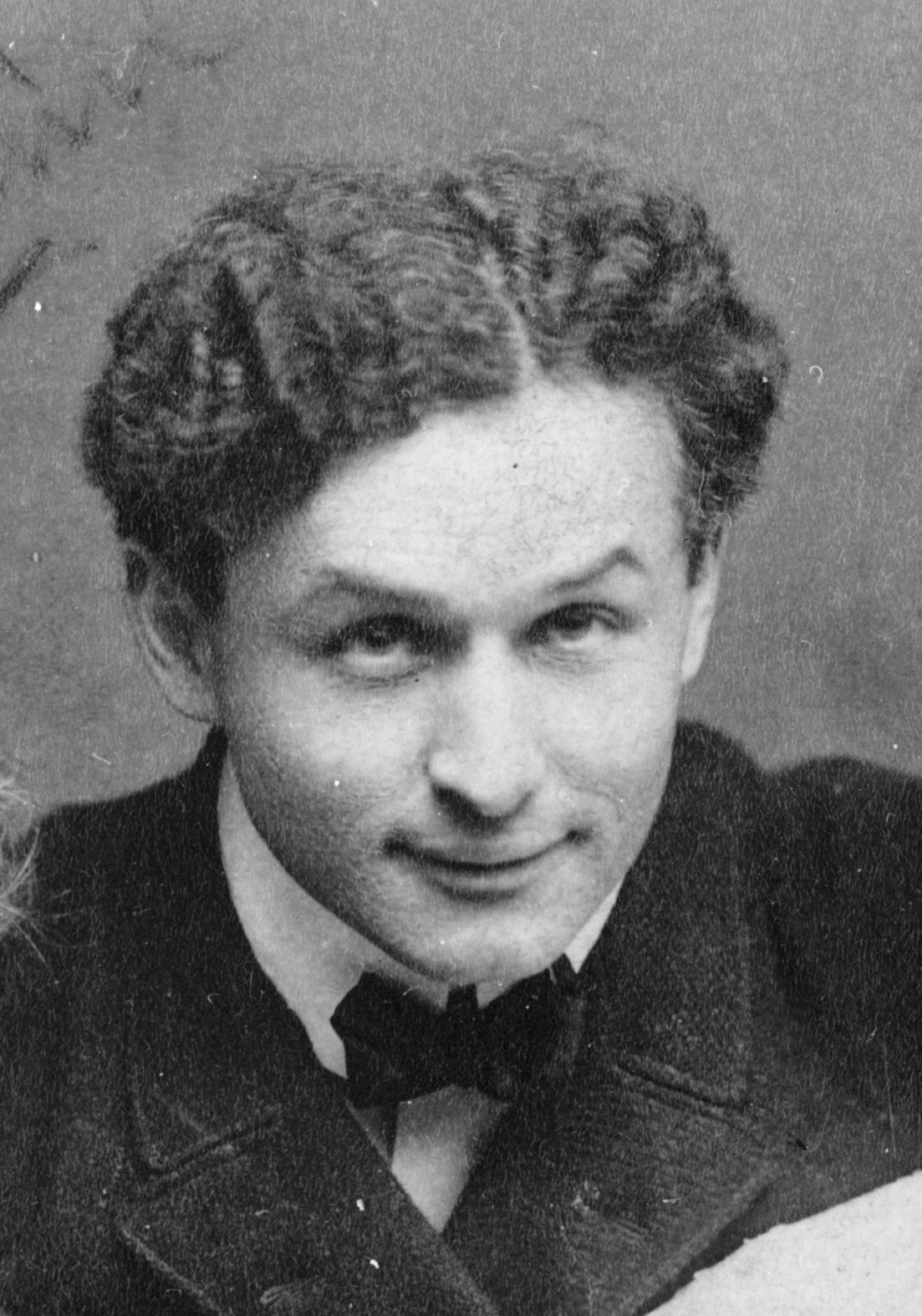
Photo: Library of Congress, public domain, via Wikimedia Commons
Harry Houdini died at Grace Hospital in Detroit on the afternoon of October 31, 1926. He was 52. The cause on the record was peritonitis, the infection that follows a burst appendix, and in the days before antibiotics it killed a lot of people who were nowhere near as famous.
What makes the date stick is everything that came after it. Houdini had spent the last years of his life exposing spirit mediums as frauds. He and his wife Bess had also agreed on a secret code, so that if he ever did manage to get a message back from the dead, she would know it was really him.
For ten Halloweens, she listened.
A punch in Montreal, a fever in Detroit
The trouble started on October 22, 1926, in Houdini's dressing room at the Princess Theatre in Montreal. A McGill University student named J. Gordon Whitehead asked whether it was true that Houdini could take any punch to the stomach. Houdini said something like yes, and Whitehead hit him several times before he had a chance to tighten his muscles.
Houdini was already in pain over the next couple of days and kept performing anyway. By the time the show reached the Garrick Theatre in Detroit on October 24, he was running a high fever. He got through the performance, collapsed afterward, and was taken to hospital, where surgeons found his appendix had ruptured.
Whether the punches caused the appendicitis is still argued about. Most doctors who have looked at the case doubt that a blow to the abdomen can bring on appendicitis, and it is quite possible Houdini was already ill and the punches just made him ignore the warning signs for too long. I lean toward that reading myself, though nobody can prove it either way now.
The man who made a career of not dying
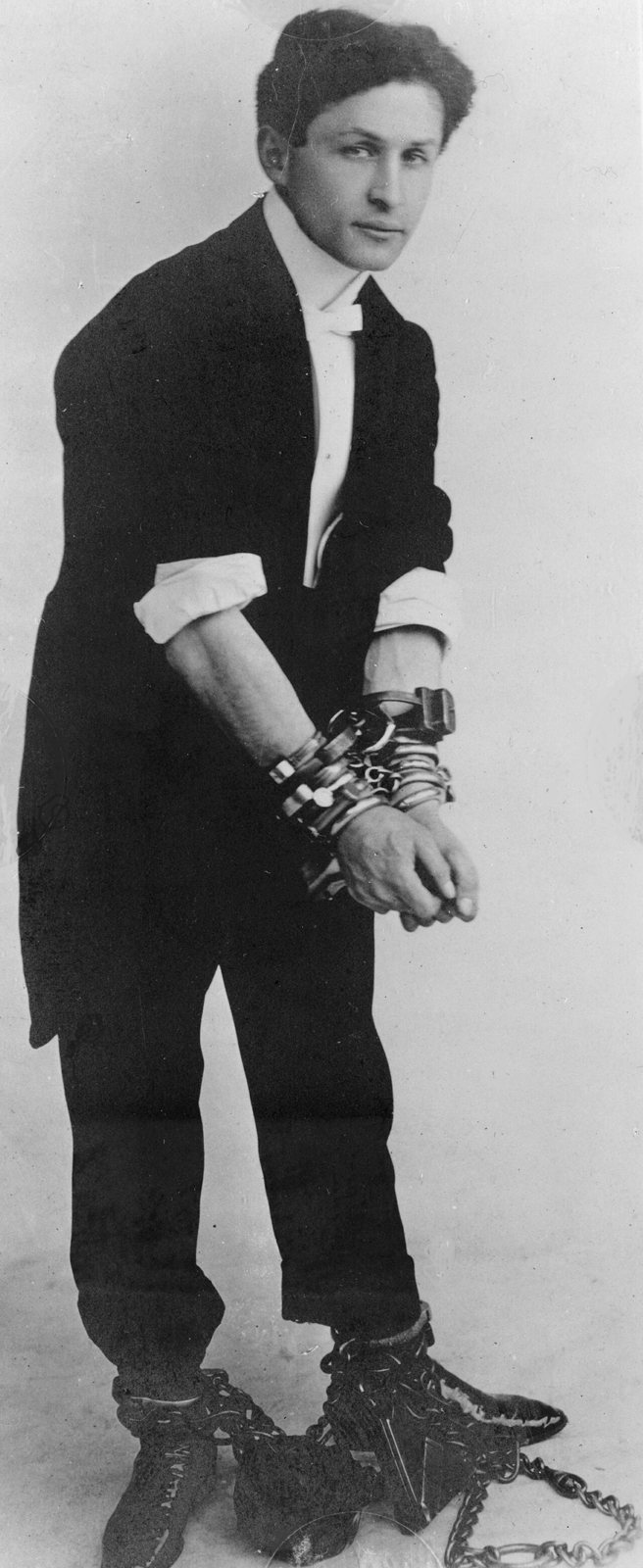
Harry Houdini in a dark suit with his wrists locked in several sets of handcuffs and his ankles chained (Photo: unknown author, public domain, via Wikimedia Commons)
Houdini was born Erik Weisz in Budapest in 1874, the son of a rabbi, and grew up in Appleton, Wisconsin, after the family emigrated to the United States. He started out in dime museums and cheap vaudeville houses doing card tricks (billing himself, at one point, as the King of Cards), and he didn't become a star until he moved on to escapes.
Handcuffs made his name, first in America and then in Europe, where he challenged local police to lock him up and walked out anyway. Then came packing crates thrown into rivers, straitjackets while hanging upside down from buildings, and, from 1912, the Chinese Water Torture Cell, in which he was lowered head first into a locked glass tank of water.
That last one produced the most stubborn Houdini myth of all: that he drowned in the tank on stage. He didn't. The story owes a lot to the 1953 film Houdini, starring Tony Curtis, which ends with him dying in the cell. It is a better movie ending than a hospital ward in Detroit, I'll grant Hollywood that.
Why a magician went after the mediums
Spiritualism, the belief that the living can talk with the dead through mediums, boomed after the First World War, when millions of families had someone to grieve. Séances were big business in the 1920s.
Houdini took it personally. His mother, Cecilia, died in 1913, and he was devastated. According to his own account, he went to mediums hoping for real contact, and what he found instead were tricks he recognized from his own trade: rapping tables, floating trumpets in darkened rooms, messages that any good cold reader could produce.
He wrote a book attacking the movement, A Magician Among the Spirits, published in 1924. That same year he sat on a Scientific American committee testing mediums for a cash prize, and he was the loudest voice against Mina Crandon, the Boston medium known as Margery. By 1926 he was testifying before Congress in favor of a bill against fortune telling for money in Washington, D.C.
It also cost him a friendship. Arthur Conan Doyle, the creator of Sherlock Holmes, was spiritualism's most famous champion, and he and Houdini had been friendly. In 1922 Doyle's wife held a séance for Houdini in Atlantic City and produced pages of automatic writing said to come from his mother. The message was in fluent English. Cecilia Weisz, by Houdini's account, barely spoke the language. The two men's falling out after that was public and bitter.
Rosabelle, believe
Before he died, Houdini and Bess settled on a code: "Rosabelle, believe." Rosabelle was the title of a song Bess had sung in her stage days, around the time they met. If a medium ever came out with those words, unprompted, it would mean something.
Bess held a séance every Halloween after his death. In 1929 a medium named Arthur Ford announced that he had received the code, and Bess at first signed a statement saying the message was correct. It didn't hold up for long. Critics pointed out that details of the code had already appeared in print, and accusations flew that the whole thing had been arranged. Bess later said the message had not come from Houdini. People who study Houdini still argue over how much Bess knew and when.
The last séance she attended was held on October 31, 1936, on the roof of the Knickerbocker Hotel in Hollywood, and it went out over the radio. Nothing happened. At the end of the night Bess put out a candle that had been burning beside a photograph of Houdini since he died, and said she would not wait any longer. Ten years, she decided, was long enough.
What remains on Halloween now
The séances didn't stop with Bess. Magicians and fans have kept holding Houdini séances every Halloween in the decades since, some of them formal events with a long line of hosts, some just friends around a table with the lights down. Nobody has reported a confirmed "Rosabelle, believe" yet, which I suspect would have pleased the old skeptic enormously.
In the United States, October 31 is also observed as National Magic Day in his memory. Houdini is buried at Machpelah Cemetery in Queens, New York, near his mother, under a monument carved with the emblem of the Society of American Magicians, which he led as president.
If you want to mark the day properly, the best way is the one he would have chosen. Find a copy of A Magician Among the Spirits, or a decent biography, and read his own account of the fake séances he sat through. Then the next time someone tells you a spirit knocked on a table, you'll know exactly how that's done.
Enjoyed this story?Get a new one every day on social.