Photo: Joyofmuseums, CC BY-SA 4.0, via Wikimedia Commons
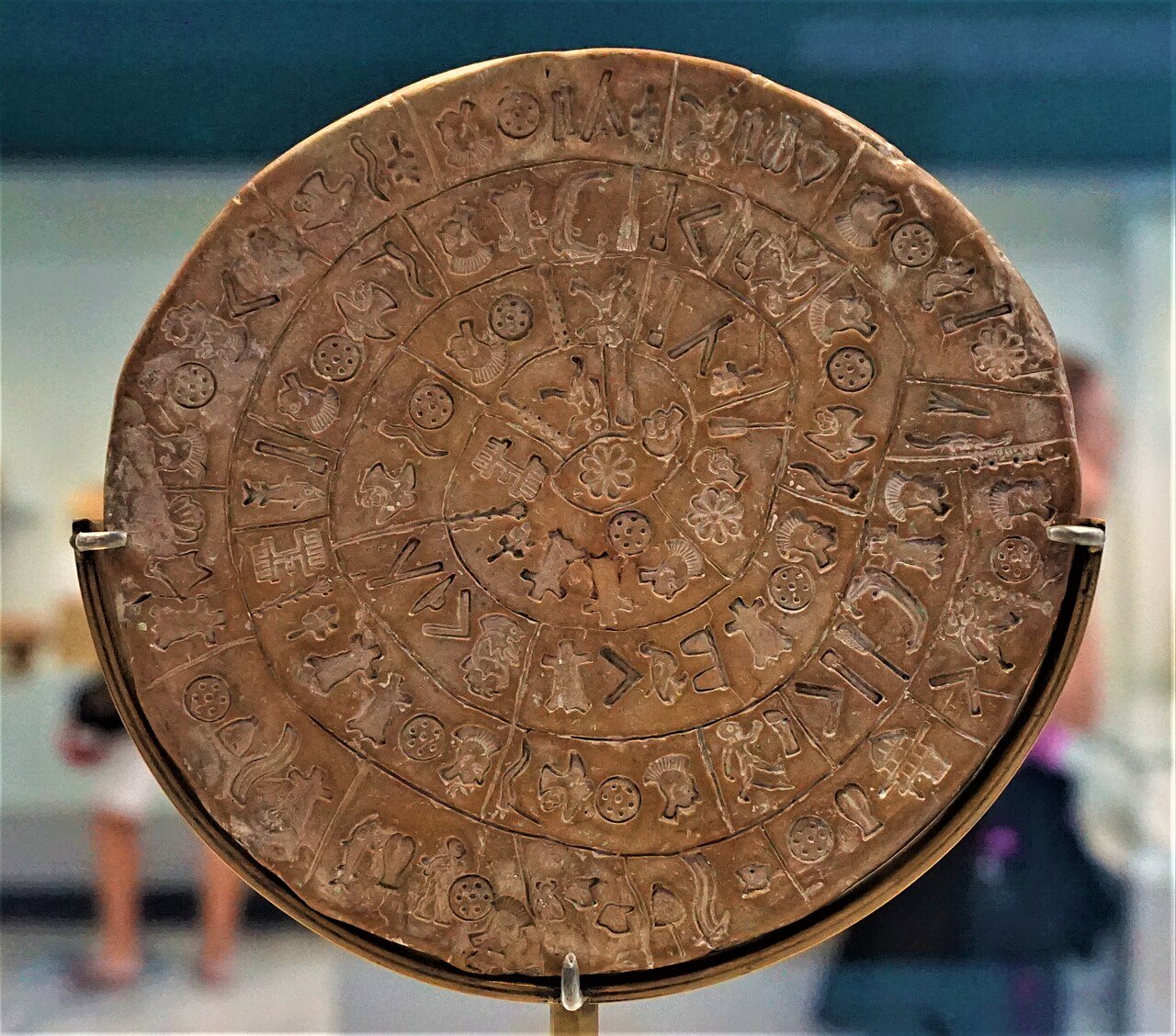
In July 1908, an Italian team digging at the Minoan palace of Phaistos, on the Messara plain in southern Crete, pulled a small disc of fired clay out of the ruins. It was about 16 centimeters across, a little smaller than a dessert plate, and both faces were covered with tiny pictures arranged in a spiral that wound from the rim toward the center.
The excavator, Luigi Pernier, knew at once that he had found writing. What he could not have known is that more than a hundred years later we would still have no idea what it says.
The Phaistos Disc now sits in a glass case in the Heraklion Archaeological Museum. Copies of it hang from earrings and sit on souvenir plates all over the island. It has not given up a single confirmed word.
What is actually on the disc
Each side carries a line of signs that spirals inward. The line is divided by short vertical strokes into compartments, and most scholars treat each compartment as a word or a phrase. There are 61 of these groups in all, 31 on one side and 30 on the other.
Count the individual signs and you get 242 (some counts give 241, depending on how a damaged spot is read). Only 45 different signs appear. Among them are a walking man, a head with what looks like a plumed or crested headdress, a woman, a child, a fish, a bird, a bow, a ship, a fist and a little rosette. The crested head is the most common sign of all, turning up 19 times.
That number, 45, is one of the few solid clues anyone has. An alphabet usually needs fewer signs than that, and a script built on whole-word pictures like Egyptian hieroglyphs needs far more. Forty-five fits nicely with a syllabary, a system where each sign stands for a syllable, which is how the known Bronze Age scripts of Crete worked.
Printed long before printing
The most remarkable thing about the disc is how it was made. The signs were not scratched into the clay with a stylus. Each one was pressed in with a stamp, a carved punch used over and over, while the clay was still soft. The disc was then fired.
That makes it, in a loose sense, the oldest known example of something like movable type. Someone went to the trouble of carving at least 45 separate stamps, which only makes sense if they planned to use them a lot. And yet the disc is the only object ever found that was printed with them. No second disc, no stamp, no tablet bearing the same impressions has ever turned up. (Archaeologists hate this. A one-off is the hardest kind of object to explain.)
The date is also less certain than you might hope. Pernier's notes place the find in a context usually dated somewhere between about 1850 and 1600 BC, in the Middle Minoan period, but the excavation records are not as tidy as modern standards would demand, and specialists still argue about the exact layer.
Why nobody has cracked it
There are two problems, and they make each other worse.
The first is size. With only 242 signs, the disc is simply too short. Cryptographers and linguists who broke other ancient scripts had far more text to work with. Linear B, the script of Mycenaean Greek, was deciphered by Michael Ventris in 1952 using thousands of tablets, and it helped that the language underneath turned out to be an early form of Greek. The disc gives nothing like that volume, so almost any proposed reading can be made to fit it.
The second problem is that we do not know the language. The Minoans also used a script called Linear A, which remains undeciphered too. Some of the disc's signs look a bit like Linear A or Cretan hieroglyphic signs, and a bronze double axe from the cave at Arkalochori carries marks that some researchers compare to the disc. Those comparisons are suggestive, and they are also hotly disputed.
The result is a small library of confident "solutions." Over the decades the disc has been read as a calendar, a board game, a hymn, a land deed, a battle report and a message in an assortment of languages ancient and modern. They cannot all be right, and so far none has convinced the field.
The most cited modern reading
The proposal that gets the most attention today came from Gareth Owens, a linguist based in Crete, working with Oxford phonetics professor John Coleman. By borrowing sound values from related Cretan scripts, Owens has argued that a few recurring sign groups refer to a mother goddess, and that the disc may be something like a hymn or prayer.
It is an interesting idea and it is grounded in real comparative work. I would still put it in the "promising, unproven" drawer. Owens himself has presented it as a partial reading, not a full translation, and plenty of specialists remain unpersuaded.
Could it be a fake?
Every famous unique object attracts this question eventually, and the disc got it in 2008, when the American antiquities dealer and scholar Jerome Eisenberg argued in print that it was a modern forgery planted at the site. His case rested on the disc's uniqueness, its unusually crisp condition and doubts about how it was recorded.
Most archaeologists rejected the argument. A thermoluminescence test, which can estimate when clay was last fired, could settle much of it, but the museum has not allowed the disc to be sampled, and a test would damage a small part of it. So the forgery question lingers in the background, mostly unloved but not fully buried.
Seeing it for yourself
If you go to Crete, the disc is on display at the Heraklion Archaeological Museum, which also holds the best collection of Minoan material anywhere, including Linear A tablets you can compare with it. It is worth looking closely at the signs: the stamps are crisp enough that you can see the outlines of the little heads and fish quite clearly.
The palace of Phaistos itself is open to visitors on its ridge above the Messara plain, and standing on the site gives you a much better feel for the place than any photograph of the disc can. Then there is the slightly maddening thought that goes with you on the way out. Somewhere under Crete there may be a second disc, or a stash of tablets in the same script, and if one ever turns up, the odds of reading this one would get a great deal better.
Enjoyed this story?Get a new one every day on social.