On the morning of October 24, 1946, a team at White Sands Proving Ground in New Mexico launched a German V-2 rocket straight up into the sky. Bolted inside it was an ordinary 35mm motion picture camera, set to take one frame roughly every second and a half. The rocket climbed to about 65 miles, or around 105 kilometers, then fell back and smashed into the desert.
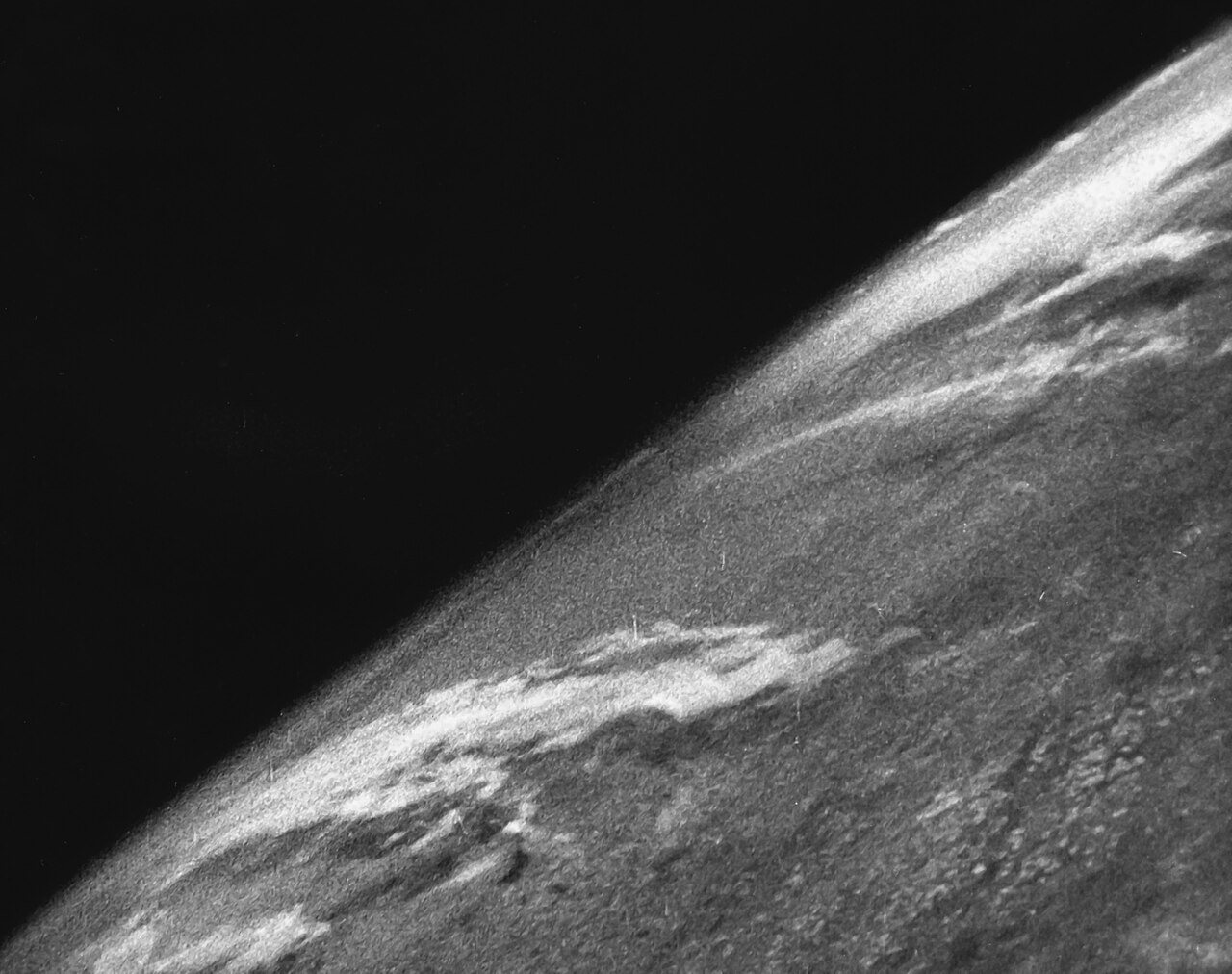
The camera did not survive. The film did. When it was developed, it showed something no one had ever seen in a photograph: the Earth from space, a curved gray horizon hanging against a black sky.
The pictures are grainy and black and white, and frankly they look a bit like a smudged X-ray. They are also the first photos ever taken of our planet from above the atmosphere, and they were shot eighty years ago today.
Where the rocket came from
The V-2 was a weapon before it was a science platform. Germany fired thousands of them at London, Antwerp and other cities in the last year of the Second World War, and the rockets were assembled in large part by forced laborers held in brutal conditions underground at the Mittelwerk plant. That history sits underneath everything that came after, and it shouldn't be skipped.
When the war ended, the United States shipped captured V-2 components and a large number of German rocket engineers across the Atlantic. The Army began test firing the rockets at White Sands in 1946. Since each launch had spare room in the nose, the military invited scientists to fill it. Researchers from universities and government labs started sending up instruments to measure cosmic rays, the upper atmosphere and the ultraviolet light of the Sun.
A camera built to be lost
One of those groups was at the Applied Physics Laboratory of Johns Hopkins University. An engineer there named Clyde Holliday worked on fitting cameras into the rockets. The plan was simple in outline and awkward in practice. The camera would film on the way up and the way down. Nobody expected it to come through the landing in one piece, because a V-2 hit the ground at several hundred miles an hour.
So the film went into a steel cassette, built to take the impact. After the launch, a recovery crew drove out to the crash site, found the wreckage and dug out the cassette. Accounts from the people who were there describe soldiers and scientists jumping around in the sand once they realized the film was intact. I can believe it. They had just watched their experiment turn into a crater.
What the frames actually show
The best known frame from the October flight shows the edge of the Earth at a steep angle, with bands of cloud lying across the desert Southwest and a thin bright line of atmosphere along the horizon. Above that line, the sky is simply black.
It's easy to undersell how odd that would have looked in 1946. People had flown balloons high enough to see a curved horizon, and in 1935 the Explorer II balloon crew had taken photographs from about 13 miles up. But 65 miles is a different kind of altitude. At that height there is almost no air left to scatter sunlight, which is why the sky goes dark even in daytime. The frames from the V-2 were the first photographic proof of that view.
Holliday later wrote about the work for National Geographic in 1950. His point, roughly, was that the pictures showed how Earth would look to a visitor arriving from another planet. That was not a throwaway line at the time. Hardly anyone had thought about the planet as something you could look at from outside.
Higher flights and the first mosaics
The October launch was not a one off. The same kind of experiment flew again on later V-2s and on other rockets through the late 1940s. Cameras went higher, and engineers began stitching individual frames together into wide panoramas that covered huge stretches of the American Southwest in a single image. Some of those composites, put together at the Applied Physics Laboratory, show the curve of the Earth across hundreds of miles.
There was a practical side to all of this. Weather forecasters were very interested in being able to see cloud systems from above, and the rocket photos were an early hint of what that could look like. The first weather satellite, TIROS-1, did not launch until 1960, but the idea was already sitting in those film canisters from White Sands.
Where the photo fits in the space age
It is a little strange that the October 1946 frames are not better known. Ask most people to name the first picture of Earth from space and they will probably think of Earthrise, taken by the Apollo 8 crew in 1968, or the Blue Marble photo from Apollo 17 in 1972. Both are wonderful pictures, but neither was the first.
Even among satellites, the White Sands film came early. Explorer 6 sent back the first crude satellite image of Earth in 1959, thirteen years after the V-2 flight. By then the camera had moved from a box that was expected to break on landing to an electronic system that radioed its pictures home.
There's also a quiet argument hiding in the word "space." Today the most commonly used boundary, the Kármán line, sits at 100 kilometers (a convention people agreed on, not anything physical you'd bump into). The V-2 peaked at about 105. So the rocket only just crossed the line, by a margin of a few kilometers. That's close enough that I'd call it a photo from space without much hesitation, though I know some purists would argue the point.
How to see the pictures yourself
The original frames are public domain, since they were made by the U.S. Army, and good scans are on Wikimedia Commons along with the later stitched panoramas. If you look at them, look at the full sequence rather than one frame. Watching the horizon tilt and swing as the rocket tumbled is the closest you can get to riding along.
White Sands Missile Range, as it is now called, also has a museum and an outdoor missile park near the range headquarters in New Mexico, with a V-2 on display. It's worth checking the range's current visitor rules before you go, since access is controlled. The camera from the 1946 flight is long gone, but the rocket on display is the same type that carried it, and it is bigger than you expect.
Enjoyed this story?Get a new one every day on social.