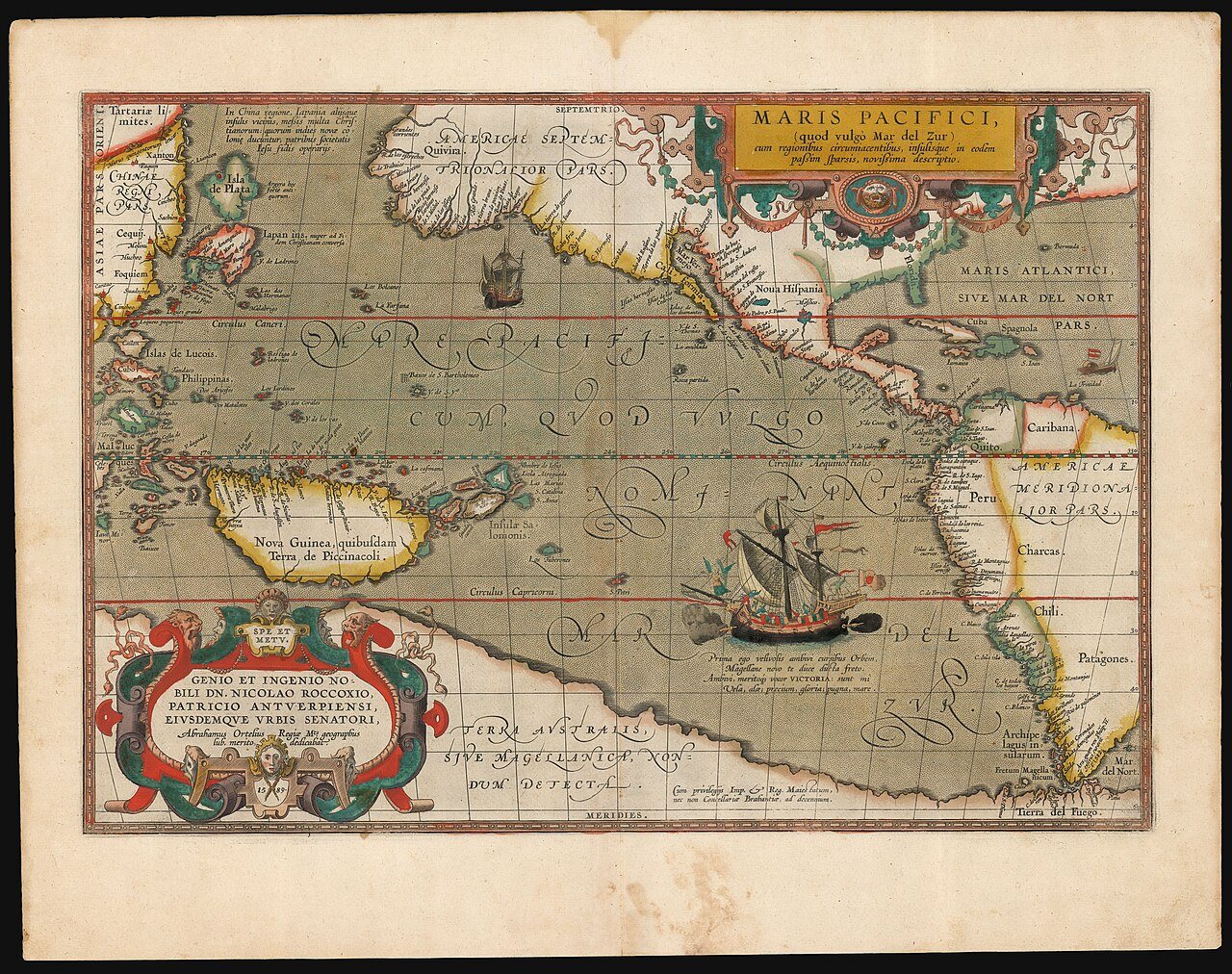
Map: Abraham Ortelius, Maris Pacifici (c. 1589), public domain, via Wikimedia Commons
On November 28, 1520, three wooden ships came out of the western end of a long, cold channel at the tip of South America and found open water in front of them. Behind them lay 38 days of fog, squalls and dead-end inlets. Ahead was a sea so quiet that day that Ferdinand Magellan called it the Mar Pacífico, the peaceful sea.
He had left Spain the year before with five ships and roughly 270 men. By the time the fleet reached that ocean, one ship had been wrecked, another had slipped away and sailed home, and Magellan had already put down a mutiny. The worst of the voyage was still in front of them.
Most of us learn this in school as a single line: Magellan's expedition was the first to sail around the world. The day the fleet reached the Pacific is the part of the story I find more interesting, because it is the moment the plan stopped being a theory.
A Portuguese captain sailing for Spain
Magellan was Portuguese, but the king of Portugal had turned him down, so he took his idea to Spain. The idea was simple to say and very hard to do. The Spice Islands, the Moluccas in what is now Indonesia, were the source of cloves and nutmeg worth a fortune in Europe. Portugal reached them by sailing east around Africa. Magellan proposed reaching them by sailing west, through a passage he believed cut across South America somewhere south of the known coast.
The young King Charles I of Spain (soon to be Holy Roman Emperor Charles V) backed him. The fleet of five ships, the Trinidad, San Antonio, Concepción, Victoria and Santiago, left Sanlúcar de Barrameda on September 20, 1519. Several of the Spanish captains resented taking orders from a Portuguese commander, and that tension shaped the next year.
Mutiny and a winter at Port San Julián
The fleet crossed the Atlantic, touched Brazil and worked its way down the coast of what is now Argentina, checking every wide bay in case it was the strait. None were. As the southern winter set in, Magellan stopped at a sheltered harbor he called Port San Julián.
Around Easter 1520, captains of three ships rose against him. Magellan regained control quickly and with force. One captain was killed in the fighting, another was executed, and two men were later left behind on the shore when the fleet sailed on. It was brutal, and it worked; nobody seriously challenged his command again while he lived.
The fleet also lost the Santiago that winter. It was sent ahead to scout and was wrecked on the coast, though most of its crew survived and made their way back to the others.
Thirty-eight days inside the strait
On October 21, 1520, the ships rounded a headland and entered a deep opening heading west. Magellan named the headland Cape of the Virgins, after the feast day. The passage turned out to be a maze, roughly 570 kilometers (about 350 miles) long, with narrows, side channels, sudden winds off the mountains and very cold water.
On the southern shore the sailors saw the fires of the local people burning at night, and the land got the name it still carries, Tierra del Fuego, the land of fire.
Somewhere in that maze the San Antonio, the largest supply ship, disappeared. Its crew had turned back, and the ship sailed home to Spain with a good share of the fleet's food. That loss mattered enormously a few weeks later.
Antonio Pigafetta, an Italian scholar who sailed with the fleet and kept the best surviving account, wrote that when the ships finally saw the open ocean, Magellan wept with joy. I'm inclined to believe him. After a year of doubt, a mutiny and a missing ship, the strait was real.
The calm sea that nearly killed them
The relief didn't last long. Nobody in Europe had any idea how wide the Pacific was. Magellan seems to have expected a short run to the Spice Islands. Instead the three remaining ships sailed for more than three months, from late November 1520 until early March 1521, before they reached Guam and got fresh food.
Pigafetta's description of that crossing is hard to read. The biscuit had turned to powder full of worms. The men ate sawdust, rats and the leather wrapped around the yards to stop chafing, soaking it in seawater first to soften it. Scurvy swelled their gums so they could not eat at all, and many died.
The ocean was kind to them in one respect: they met no serious storms, which is how the name stuck. (Anyone who has read about Pacific typhoons may find that a little ironic.)
How the voyage ended
Magellan never finished his own circumnavigation. In April 1521 he was killed in a fight on Mactan, in the Philippines, after getting involved in a local conflict. More men died or were lost in the months that followed. The Concepción was burned for lack of crew, and the Trinidad was later captured by the Portuguese.
Only the Victoria made it home, under the command of Juan Sebastián Elcano, a Basque officer who had taken part in the San Julián mutiny. It reached Spain in September 1522 with 18 of the original crew aboard, carrying a cargo of cloves. When Abraham Ortelius published the first printed map devoted to the Pacific in 1589, the ship he drew in the middle of the ocean was the Victoria, with a Latin verse in her honor beneath her. Elcano, not Magellan, was the first captain to bring a ship all the way around the world.
Seeing the strait today
The Strait of Magellan is still there, of course, and still used, mostly by ships avoiding the open seas around Cape Horn. Punta Arenas in Chile sits on its shore and is the usual base for visitors, with boat trips into the channels and a full-size replica of the Victoria on display.
If you want the story in the words of someone who was there, Pigafetta's account is widely available in English translation and is shorter than you might expect. Read the chapter on the Pacific crossing first. It explains better than any summary why reaching that calm water on November 28 felt like a triumph, and why it was really only the halfway point.
Enjoyed this story?Get a new one every day on social.