Wellcome Collection, CC BY 4.0, via Wikimedia Commons
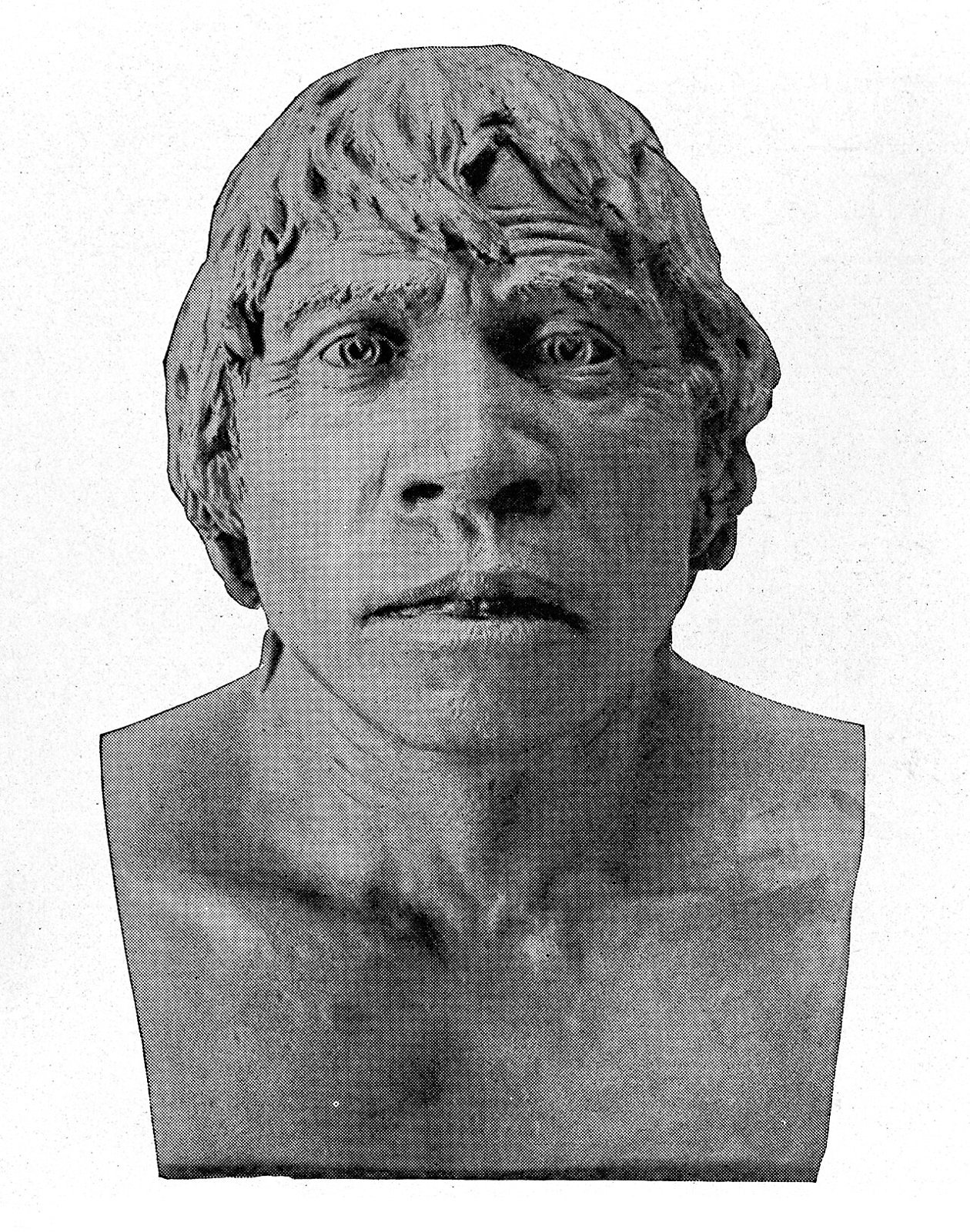
On the evening of 18 December 1912, a packed room at the Geological Society of London heard that the missing link had turned up in a gravel pit in Sussex. The speakers were Charles Dawson, a country solicitor with a lifelong habit of finding remarkable things, and Arthur Smith Woodward, Keeper of Geology at the British Museum (Natural History). Between them sat a reconstructed skull with a large, humanlike braincase and a jaw that looked very much like an ape's.
They called it Eoanthropus dawsoni, Dawson's dawn man. The newspapers called it the first Englishman, and for about forty years most of British science agreed.
It was a fake. The braincase was human, the jaw came from an orangutan, and someone had filed the teeth and stained the lot to look ancient. The forgery itself was fairly crude. The part that still bothers me is how long it lasted.
A gravel pit, a solicitor and a museum keeper
Dawson's account was that workmen digging gravel at Barkham Manor, near the village of Piltdown, had handed him a piece of thick skull some years earlier. In February 1912 he wrote to Woodward, and that summer the two of them dug the pit together. A young French Jesuit and trained palaeontologist, Pierre Teilhard de Chardin, joined them for some of the work.
The finds came steadily. More skull fragments, half a lower jaw with two molars, animal teeth and flint tools that suggested great age. In 1913 Teilhard found a canine tooth. In 1914 the pit produced a slab of fossil elephant bone shaped into something that looked, absurdly, like a cricket bat. (I am not making that up, and in hindsight it should have set off a few more alarms than it did.)
Then, in 1915, Dawson reported a second set of fragments from another field a couple of miles away. Piltdown II, as it came to be called, persuaded many of the remaining sceptics. Two separate sites with the same strange mix of features seemed hard to explain as coincidence. Dawson died in August 1916, and the finds stopped with him.
Why the experts wanted it to be true
Piltdown fitted what many researchers already expected. The popular view in Britain held that a big brain came first in human evolution and the rest of the body caught up later. A large skull paired with a primitive jaw was exactly that story in bone. It also gave England a starring role at a time when France and Germany had the most impressive early human finds.
There were doubters from the start, notably among some anatomists in the United States, who argued the jaw simply belonged to an ape. But the original fossils were kept locked away in London, and most researchers were shown plaster casts, which hide exactly the sort of file marks and staining that would later give the game away.
The cost of that belief showed up in 1925, when Raymond Dart described the Taung Child from South Africa. It had a small brain and humanlike teeth, the opposite pattern to Piltdown. Many senior figures dismissed it, and Piltdown was part of the reason. Dart turned out to be right, though it took the best part of two decades for the field to come round.
How the fake came apart
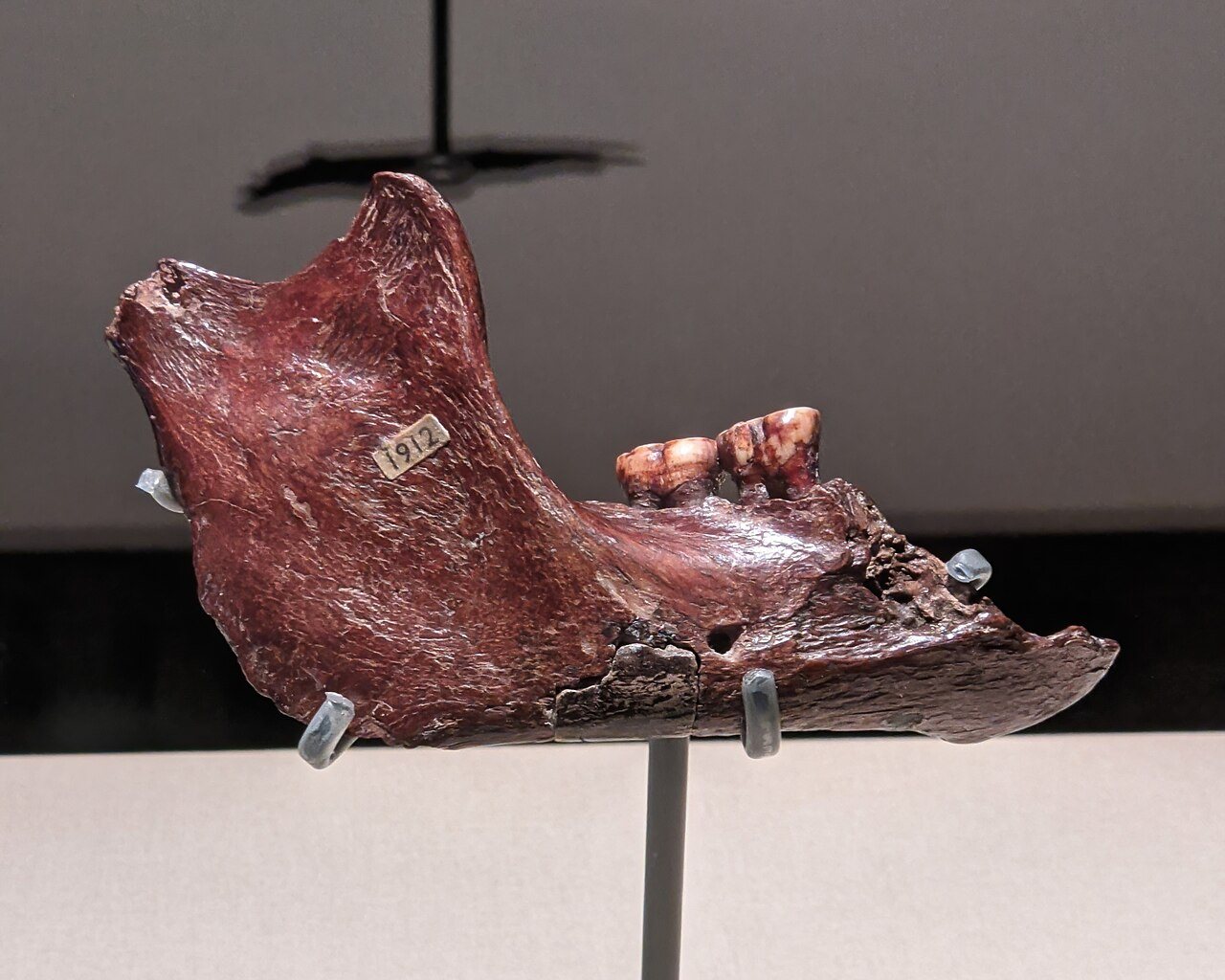
The Piltdown jaw and its two filed molars as displayed at Melbourne Museum. Photo: Ethmostigmus, CC BY-SA 4.0, via Wikimedia Commons
The unravelling started with chemistry. Bones buried in the ground absorb fluorine from groundwater over time, so the amount can show whether bones from the same deposit are really the same age. In 1949 Kenneth Oakley of the museum ran fluorine tests on the Piltdown material and found far less than expected. The remains were much younger than the gravel around them.
In 1953 Joseph Weiner, Wilfrid Le Gros Clark and Oakley went further. Under the microscope, the molars showed scratches from filing that had flattened them to look like human wear. The dark brown colour turned out to be a surface stain applied to make everything match, the canine had been painted, and the cricket bat showed cuts from a steel blade. The museum published the findings in November 1953, and the "first Englishman" was front-page news for the second time.
Who did it
Nobody ever confessed, which is why Piltdown has kept a small industry of amateur detectives busy ever since. Suspects over the years have included Teilhard de Chardin, Arthur Conan Doyle (who lived nearby and liked a good puzzle) and Martin Hinton, a museum zoologist whose old trunk, found in the 1970s, held bones stained in a similar way.
The strongest case has always pointed at Dawson. He was present at almost every find, nothing turned up after his death, and the archaeologist Miles Russell has catalogued dozens of other Dawson discoveries that look doubtful on close inspection. In 2016 a team led by Isabelle De Groote and Chris Stringer published a fresh study of the remains using DNA, CT scanning and dating. They concluded the jaw and teeth most likely came from a single orangutan, the skull pieces from at least two humans who were probably medieval, and that the same packing methods and repairs ran through both Piltdown sites. Their verdict was one forger, very probably Dawson. I find that convincing, although I'd stop short of calling the case closed, since a dead solicitor can't be cross-examined.
What Piltdown still teaches
The Natural History Museum in London still holds the remains, and there is still a memorial stone at Barkham Manor marking where the "discovery" was made. It was put up in 1938, which makes it one of the odder monuments in England.
It would be easy to read Piltdown as proof that scientists are gullible, but science did catch the fake, with tests nobody had in 1912. What interests me more is why it survived so long. The find told experts what they hoped to hear, hardly anyone got to handle the originals, and one man stood behind nearly every discovery.
When the next sensational fossil makes headlines, it is worth checking whether anyone outside the original team has examined the actual material, and whether it has been dated by more than one method. I'd also be a little wary of any find that confirms a favourite theory too neatly. Most new discoveries clear those bars without trouble, which is the reassuring part. Piltdown cleared none of them.
Enjoyed this story?Get a new one every day on social.