The Step Under the Workmen's Huts That Led to Tutankhamun's Tomb
Howard Carter's pocket diary for November 4, 1922, has one of the great understatements in archaeology: "First steps of tomb found." Five words. He had been working toward that sentence for most of his adult life, and he wrote it like a man noting a dentist appointment.
The diary leaves out who found them. That omission has kept people arguing for a century, and it's the part of the story I like best, because it is one of the few things about Tutankhamun's tomb that nobody has managed to settle.
One last season of digging
By 1922 Carter was running out of road. He had come to Egypt in 1891 as a teenage draftsman with little formal schooling, climbed to Inspector of Monuments for Upper Egypt, then resigned in 1905 after a row known as the Saqqara Affair. Lord Carnarvon, a wealthy English aristocrat, took him on a few years later, and the two spent years digging in the Valley of the Kings with not much to show for it.
Carnarvon was ready to stop paying. After a conversation with Carter he agreed to fund one more season, and that season is the reason anyone remembers either of them.
Carter's crew went back to a patch of ground below the entrance to the tomb of Ramesses VI, where the remains of ancient workmen's huts still stood. Clearing them was the job nobody had bothered with. Three days into the work, a step appeared in the rock.
Who actually found it
Carter's published account says his workmen uncovered the step while digging beneath the huts. That is about as specific as he got. Then, in the years afterward, a boy started appearing in the story.
The Boston Globe reporter Karl Kitchen wrote in 1924 that a boy named Mohamed Gorgar found the step, though Gorgar never confirmed it. Lee Keedick, who organized Carter's American lecture tour, said Carter himself credited an unnamed boy who carried water for the crew. The former Egyptian antiquities chief Zahi Hawass has named the water boy as Hussein Abd el-Rassul, based on a conversation with el-Rassul.
The trouble is that these accounts don't line up neatly. The historian Christina Riggs has suggested the popular version may be a blend of Keedick's anecdote and el-Rassul's later claim to be the boy photographed wearing Tutankhamun's jewelry in 1926. My own guess, for what it's worth, is that some Egyptian worker with a very ordinary job did see it first, and that his name was never written down because nobody at the time thought it mattered.
Three weeks of waiting on a staircase
The crew cleared enough steps the next day to reach a sealed doorway. Then Carter did something remarkable, which was nothing. He covered the staircase back up and sent a cable to England reporting a "magnificent tomb with seals intact," then sat and waited for his sponsor.
Imagine that for a moment. He had reason to believe he had found an unrobbed royal burial, and he spent the better part of three weeks guarding a hole in the ground. Carnarvon arrived on November 23 with his daughter, Lady Evelyn Herbert. The next day the full stairway was cleared, and a seal on the outer door carried the name Tutankhamun.
"Wonderful things," or something like it
On November 26, Carter made a small breach in the second doorway and held a candle to it. Carnarvon asked whether he could see anything. The reply that went into the book was "Yes, wonderful things!"
His own journal has it as "Yes, it is wonderful," which is less quotable and probably closer to what a stunned man would say. The published line has outlived the original by a wide margin, as these things tend to.
The official opening came on November 29, with dignitaries and Egyptian officials present. There's a persistent claim that Carter, Carnarvon and Lady Evelyn had already been further inside than they admitted, getting into the burial chamber through an old robbers' passage a day or so earlier. Many accounts now accept it. The burial chamber was formally opened in mid-February 1923.
The curse, the quarrel and the slow work
Carnarvon barely saw any of it. He contracted blood poisoning, reportedly from an infected mosquito bite, and died in Cairo on April 5, 1923. The newspapers had been hungry for this story already (Carnarvon had sold exclusive rights to The Times, which annoyed every other paper on earth) and his death handed them a curse. Carter, the man who actually went into the tomb first and spent years inside it, lived until 1939 and died of Hodgkin's disease at 64. As curses go, it was badly aimed.
The real work took about a decade. The expedition photographer, Harry Burton, took around 1,800 pictures, and they remain among the best records anyone has of an excavation in progress. A dispute with the Egyptian authorities shut the dig down for most of a year in 1924 and 1925, and the last of the clearance didn't finish until February 1932.
Where to see it now
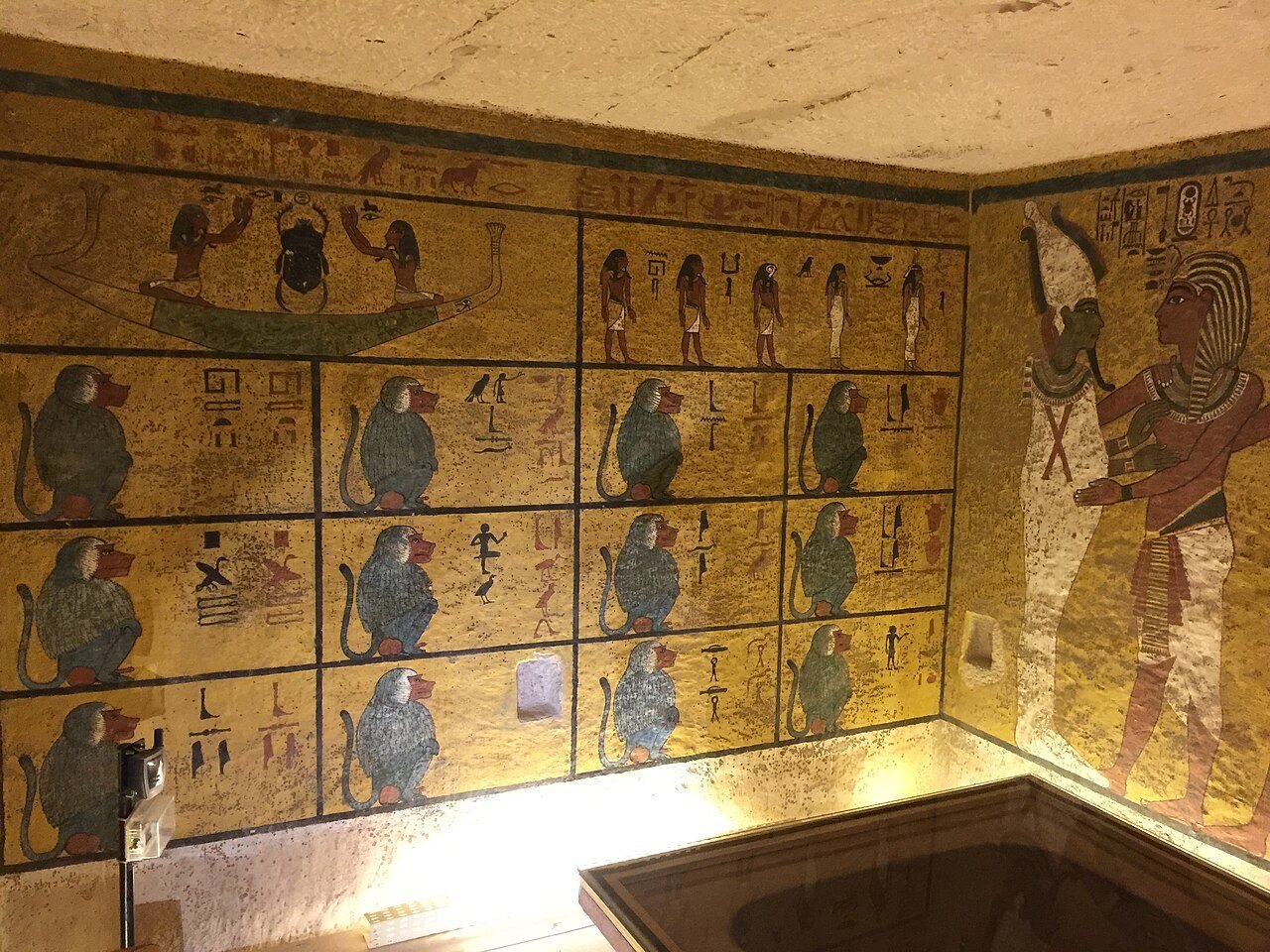
Tutankhamun's mummy is still in the Valley of the Kings, in the tomb now catalogued as KV62. Most of what Carter's team lifted out went to Cairo, and the collection has since moved to the Grand Egyptian Museum near the Giza pyramids, which opened officially in November 2025 and shows it together.
If you go, spend a minute on the ground outside KV62. The staircase is short and the spot is unremarkable, tucked below a much larger tomb, and that goes a long way toward explaining why generations of archaeologists walked past it. (Ancient robbers did get in, twice by most accounts, and the tomb was resealed both times.) An exhibition at Oxford's Bodleian Libraries made a point of putting the Egyptian crew back into this story. Whether anyone ever pins down the person who saw that first step is another matter, and I wouldn't bet on it.