Photo: Steve Jurvetson, CC BY 2.0, via Wikimedia Commons
At about 10:30 on the night of October 29, 1969, a UCLA graduate student named Charley Kline sat at a terminal in room 3420 of Boelter Hall and started typing the word LOGIN. The computer he was trying to reach sat in Menlo Park, at the Stanford Research Institute, roughly 350 miles up the coast.
He had a phone to his ear the whole time. On the other end was Bill Duvall, a programmer at SRI, and the two men checked each letter as it went. Kline typed L. Duvall said he had the L. Kline typed O. Duvall had the O. Kline typed G, and the SRI system crashed.
So the first message ever sent across the ARPANET, the network that grew into the internet, was "LO." Leonard Kleinrock, who ran the UCLA lab, has spent the decades since pointing out that you could hardly have scripted a better one, as in "lo and behold." I'm inclined to agree with him, even if nobody planned it.
A Pentagon office with three terminals
The network started with an annoyance. In 1966 Bob Taylor, who ran the computing research office at the Pentagon's Advanced Research Projects Agency (ARPA), had three separate terminals in his office. Each one connected to a different research computer at a different site, and none of them could talk to the others.
Taylor thought that was silly, and expensive. ARPA was paying for big machines at universities around the country, and each group was duplicating work the others had already done. He got funding approved to link them, and he hired Larry Roberts, a researcher from MIT's Lincoln Laboratory, to design the thing.
The plan leaned on an idea called packet switching. Instead of holding open a single circuit between two points, like a phone call, a message would be chopped into small blocks and sent through the network, then put back together at the far end. Paul Baran at the RAND Corporation and Donald Davies at Britain's National Physical Laboratory had worked out versions of it independently earlier in the decade. Davies is the one who called the blocks "packets."
The refrigerator-sized box from Cambridge
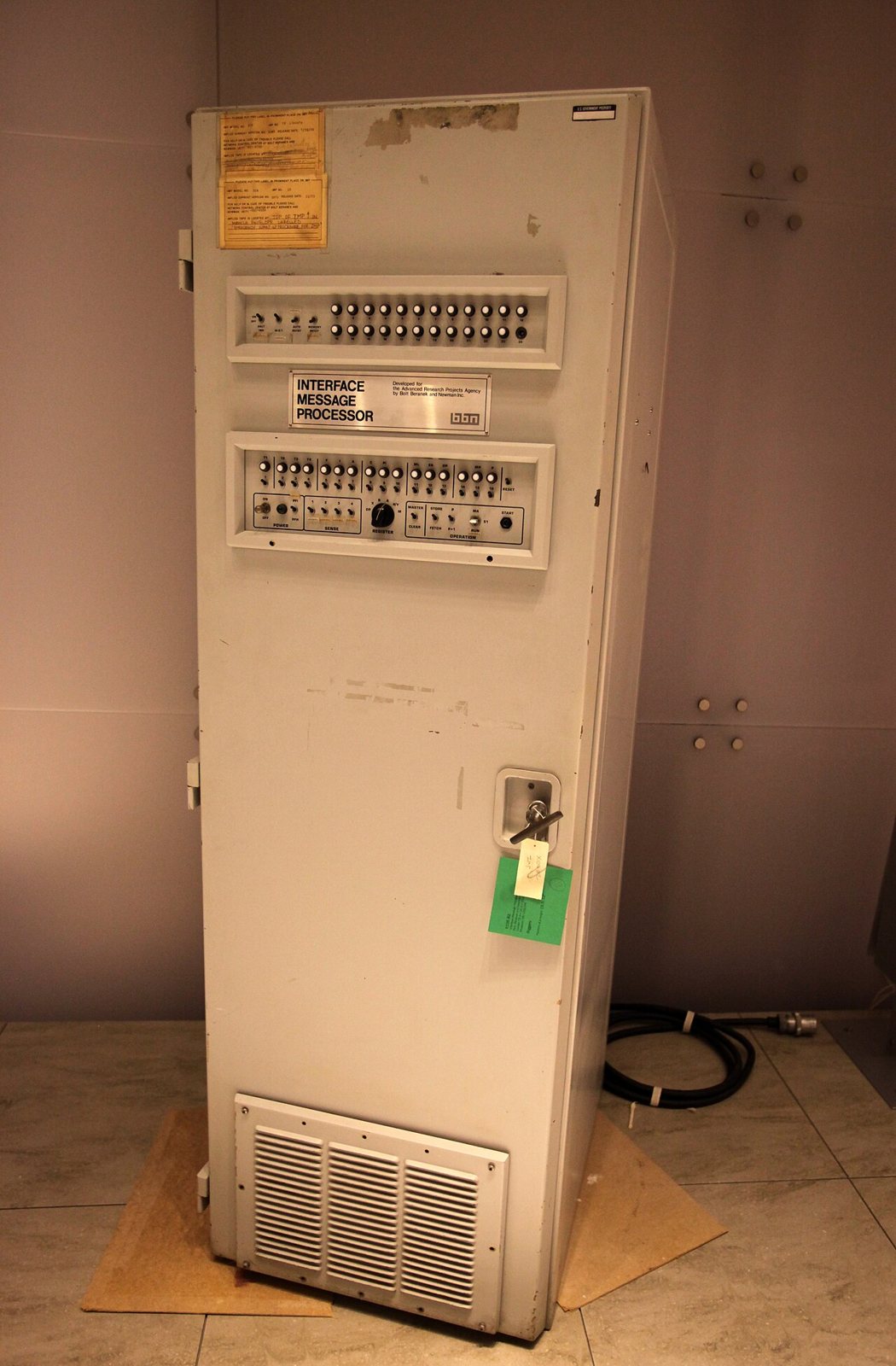
Nobody wanted to rewrite the software on every host computer to handle the network, so the design put a small dedicated computer at each site to do the job. These were called Interface Message Processors, or IMPs. The contract to build them went to Bolt Beranek and Newman, a firm in Cambridge, Massachusetts, which put the work on ruggedized Honeywell DDP-516 minicomputers.
The first IMP arrived at UCLA at the end of August 1969, around Labor Day. The second reached SRI in early October. By the standards of the day they were compact, though by ours each one is about the size of a refrigerator (the cover photo shows the kind of cabinet I mean).
UCLA had been chosen as the first site partly because of Kleinrock. He had done early mathematical work on how data would queue and flow through a network like this, and his lab was set up to measure how the thing actually behaved.
What really crashed on October 29
The crash has become part of the legend, and the explanation is less dramatic than it sounds. SRI's machine had a helpful feature that tried to finish the word LOGIN once it recognized the start of it. When the G arrived, the SRI side tried to send back the rest of the word, and something in the handling of those extra characters fell over. Accounts differ slightly on the exact fault, depending on who is telling it, and I wouldn't lean too hard on any single version.
What everyone agrees on is that the fix took about an hour. Kline tried again and logged in properly. The lab kept a handwritten log of its work, and the entry for that night reads "22:30 Talked to SRI Host to Host," with Kline's initials next to it. It is one of the plainer documents in the history of technology. It's also one of my favorites.
The nuclear war story that won't go away
Ask around and someone will tell you the ARPANET was built so the United States could keep communicating after a nuclear attack. It's a durable story, and it has a grain of truth in it. Baran's packet switching work at RAND really was about building a communications system that could survive heavy damage.
But the ARPANET itself was funded to let researchers share computers and results. Taylor spent years correcting the record on this, sometimes with visible irritation. The two stories got blended because the network used ideas that had been developed with survival in mind, and a network built from small, interchangeable pieces happens to be hard to knock out, which is a nice side effect but wasn't why the money was spent.
Four computers by Christmas
The network grew quickly once it worked. The University of California, Santa Barbara joined in November 1969, and the University of Utah in December. By the end of the year there were four nodes. More universities and government labs followed through the early 1970s.
In 1971 Ray Tomlinson at BBN sent messages between machines using the @ sign to separate the user from the computer, which is the email address format we still use. On January 1, 1983, the ARPANET switched over to the TCP/IP protocols developed by Vint Cerf and Bob Kahn, and that changeover is the date many historians give as the real birth of the internet. The ARPANET itself was shut down in 1990, by which time newer networks had taken over its work.
Where to see it now
Room 3420 in Boelter Hall at UCLA has been restored to look roughly as it did in 1969, and it opened in 2011 as the Kleinrock Internet Heritage Site and Archive, complete with an original IMP. If you're visiting Los Angeles and have a soft spot for the history of technology, it's worth checking UCLA's site for current visiting arrangements before you go.
The Computer History Museum in Mountain View, California, also has IMP hardware on display. I find it oddly comforting that the whole thing began with a crash. Every email you send today runs on a system whose first attempt got as far as "LO" before someone had to go and fix it.
Enjoyed this story?Get a new one every day on social.