Print: unknown artist, Tissandier collection, public domain, via Wikimedia Commons
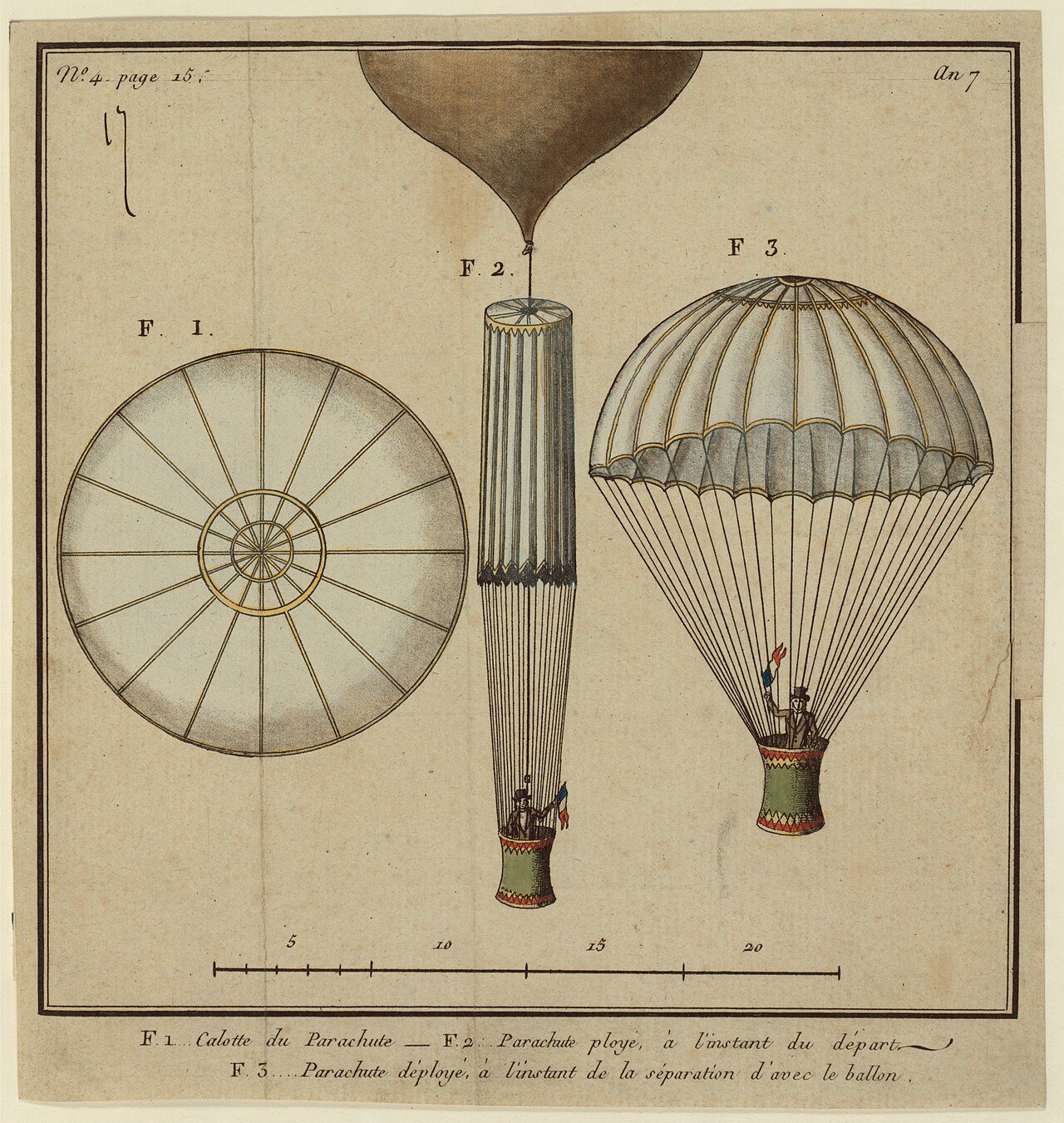
On the afternoon of 22 October 1797, a crowd in the Parc Monceau on the edge of Paris watched a hydrogen balloon climb with a strange load hanging under it: a closed canopy, folded like an umbrella, with a small basket underneath and a 28-year-old man named André-Jacques Garnerin sitting in it.
At roughly 3,000 feet, by the usual account, Garnerin cut the rope. The balloon shot upward. The canopy opened, and then it began to swing, hard, from side to side, with the basket going along for the ride. A few minutes later the basket bumped and scraped across the ground, and Garnerin climbed out unhurt.
That descent is generally counted as the first parachute jump from a height great enough to matter, and the first made from a balloon. It happened 229 years ago today.
A balloonist who learned his trade in revolutionary Paris
Garnerin was born in Paris in 1769 and studied under the physicist Jacques Charles, the man behind the first hydrogen balloon in 1783. He worked closely with his older brother, Jean-Baptiste-Olivier, and the two of them came of age just as Paris went balloon-mad.
Then came the wars. During the French Revolutionary Wars he was captured by British troops, handed over to the Austrians, and held for about three years in the fortress at Buda in Hungary. The story goes that he spent part of that time thinking about how a man might get down safely from a great height. I'd like to believe it, mostly because a prisoner in a high fortress daydreaming about parachutes is too good a detail to throw away. It is also the kind of detail that tends to get polished after the fact, so take it as a story rather than a record.
What is certain is that by 1797 he was back in Paris and ready to try.
How the Monceau parachute was built
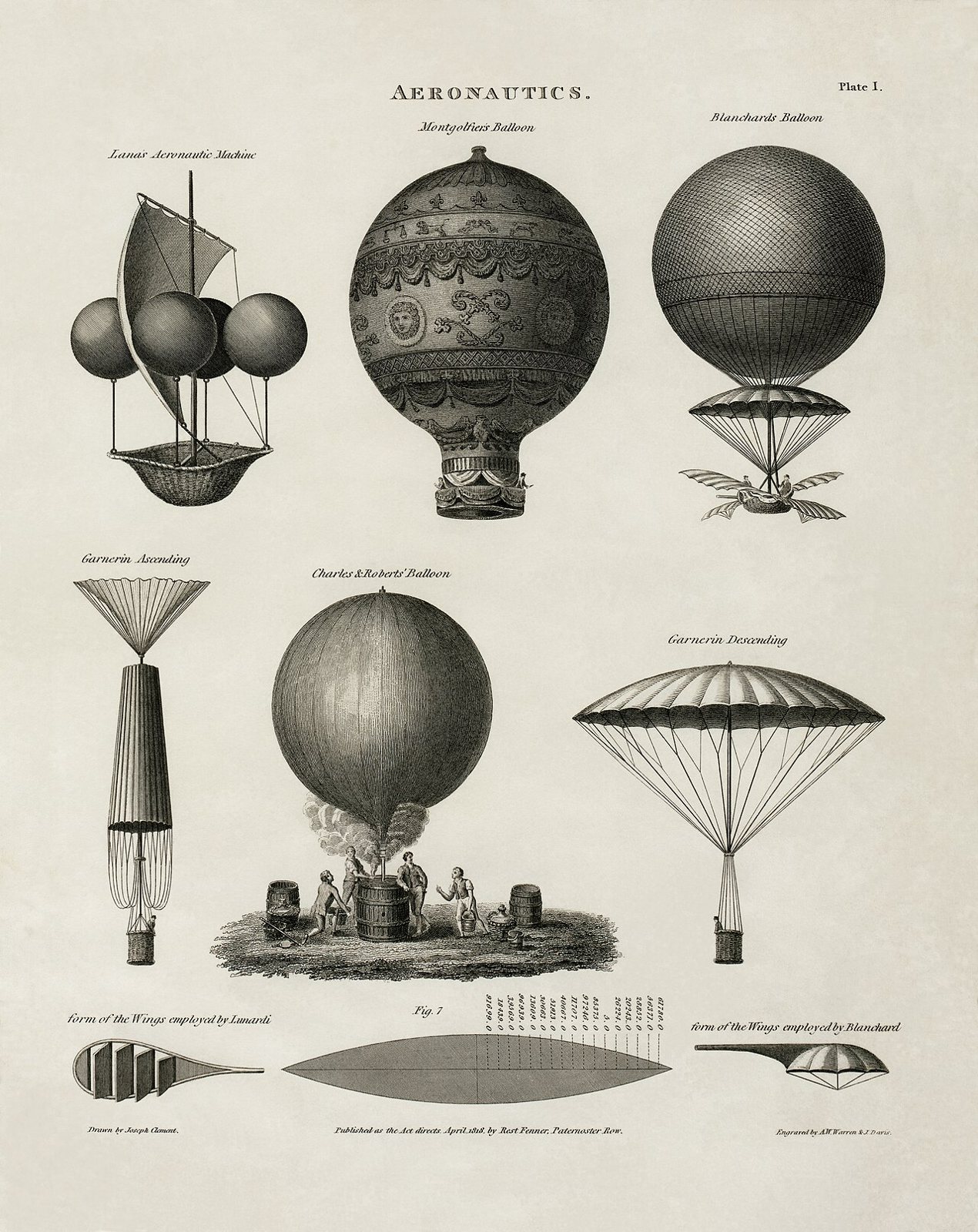
An 1818 aeronautics plate showing Garnerin's parachute folded for the ascent and open on the way down. Engraving by A. W. Warren and J. Davis after Joseph Clement, public domain, via Wikimedia Commons
The parachute was about 23 feet (7 m) across. Sources disagree on the fabric; some say white canvas and others say silk. Unlike the rigid umbrella sketches that inventors had been drawing for centuries, it had no fixed frame holding it open. It was folded shut for the ascent and attached to the balloon by a rope running through a tube, with a pole helping keep it in shape until the moment of release.
That frameless design is why Garnerin gets credit as the inventor of the modern-type parachute. Earlier attempts existed. Louis-Sébastien Lenormand jumped from the tower of the Montpellier observatory in 1783 holding what was essentially a big reinforced umbrella, and he is usually credited with coining the word "parachute". Jean-Pierre Blanchard dropped animals under small canopies from balloons in the 1780s. None of them went up a few thousand feet and let go.
Why the basket swung so violently
The swinging that frightened the Monceau crowd had a simple cause. A canopy with no opening at the top traps air, and the trapped air has to spill out somewhere, so it escapes around one edge and then the other. The basket below turns into a pendulum.
The astronomer Jérôme Lalande, who took a keen interest in ballooning, worked out the fix: cut a vent in the top of the canopy so air can escape through the middle. Garnerin's later parachutes carried one, and almost every round parachute since has had some version of it. I find that fix more interesting than the jump itself, though I accept I may be alone in that.
A family business in falling
Garnerin did not keep the act to himself. Jeanne Geneviève Labrosse, one of his students and later his wife, made her first balloon flight in 1798. On 12 October 1799 she jumped from about 900 m and became the first woman to make a parachute descent.
In 1802, during the short peace between Britain and France, the couple went to England. Garnerin flew from Ranelagh Gardens to Colchester, and on 21 September he jumped over London, coming down in a field near St Pancras in the first parachute descent made in England. The visit was not all applause; parts of the English press accused him of involvement in the worst episodes of the Revolution, which he denied.
Later came Élisa Garnerin, described in different sources as his niece or his daughter. She made dozens of professional descents across Europe between 1815 and 1836. By then the parachute jump had become a proper show, something a city put on for a crowned guest.
The coronation balloon that went too far
Garnerin was named Official Aeronaut of France, and the job came with ceremonial duties. For Napoleon's coronation in December 1804 he sent up a large unmanned balloon decorated for the occasion. As the story is usually told, the winds carried it all the way to Italy, where it came down near Rome, close to Lake Bracciano, and its crown ended up snagged on an ancient tomb popularly linked to Nero. Comparisons followed, and nobody involved enjoyed them. The accounts vary in the details, but the embarrassment is generally given as one reason the post later passed to Sophie Blanchard.
Garnerin died in Paris in 1823, aged 54, killed by a falling beam at a building site where he was working on a new balloon. It is a grim, almost too neat ending for a man who spent his career falling safely from the sky.
Where to find Garnerin today
The Parc Monceau is still there in the 8th arrondissement, smaller and much tidier than the open ground of 1797. A path in the park is named the Allée Jacques Garnerin, and a plaque marks the jump. If you are in Paris, it is a pleasant half hour; sit on a bench, look up, and try to picture a man in a basket swinging wildly against an autumn sky.
Every round parachute in use today, whether it carries a soldier or a crate of supplies, still owes something to that afternoon and to the hole in the top that Lalande suggested. Garnerin was the one who sat in the basket, of course. Lalande did his thinking afterwards, with both feet on the ground.
Enjoyed this story?Get a new one every day on social.