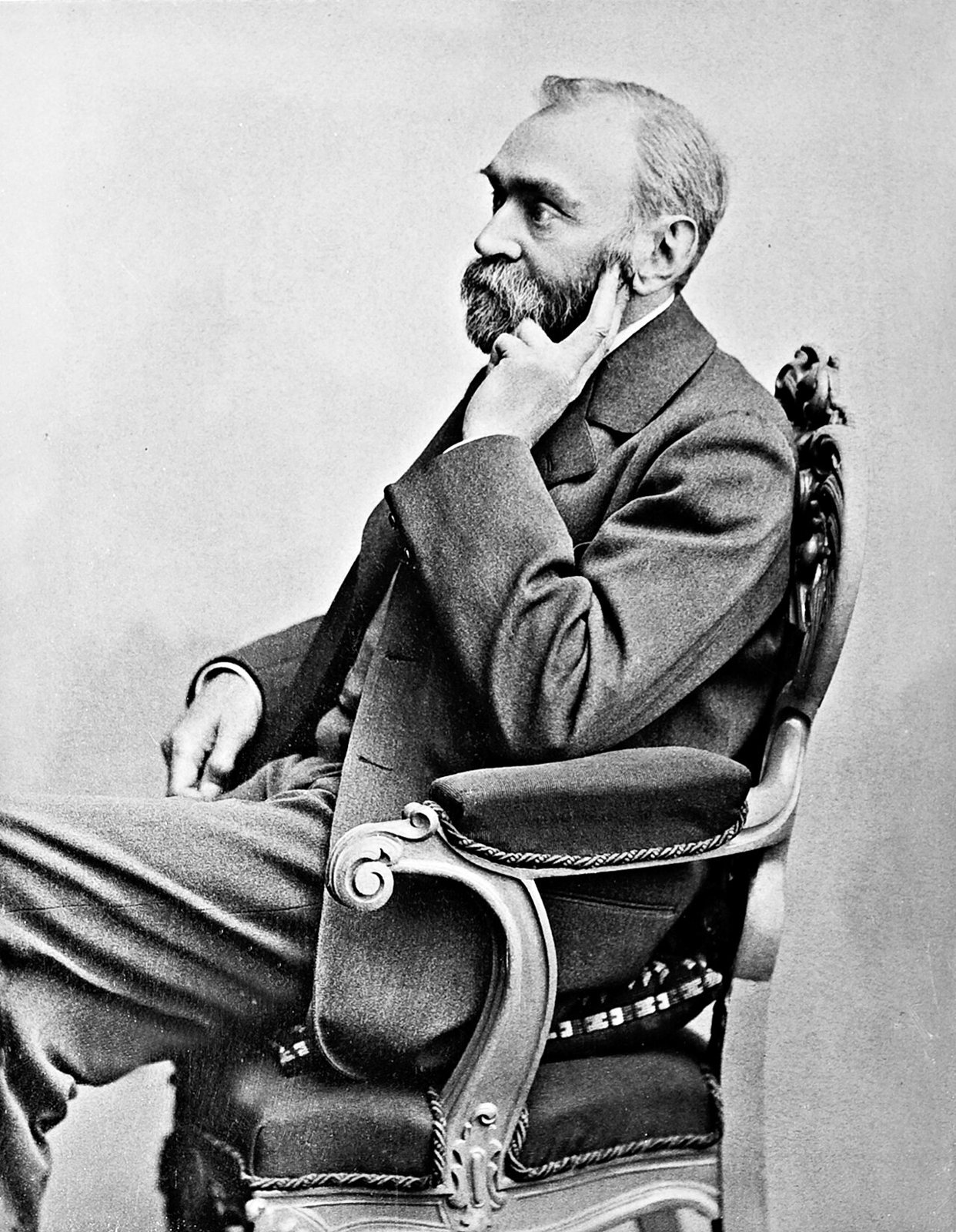
Photo: Gösta Florman / The Royal Library, public domain, via Wikimedia Commons
On November 27, 1895, Alfred Nobel walked into the Swedish-Norwegian Club in Paris, sat down with four witnesses and signed a will he had written out by hand in Swedish. It ran to about four pages. No lawyer had drafted it, and it showed.
Nobel was 62, unmarried, childless and one of the richest men in Europe. He held more than 350 patents, ran explosives factories in a string of countries and had recently bought the Bofors arms works in Sweden. Most of the people who expected a share of that money were relatives. The will gave them comparatively little.
Instead, the bulk of the estate was to be turned into safe investments, and the interest handed out every year as prizes "to those who, during the preceding year, shall have conferred the greatest benefit to mankind." Five fields were named: physics, chemistry, physiology or medicine, literature and peace. Almost nobody knew about it until after he died.
A man who made his money from explosions
Nobel's fortune came mostly from dynamite, which he patented in 1867. Nitroglycerin was powerful and horribly unstable, and the Nobel family knew the cost firsthand: Alfred's younger brother Emil was killed in an explosion at the family workshop in Stockholm in 1864. Mixing nitroglycerin with a porous earth made it safe enough to handle and ship, and mining, tunnelling and railway building took it up fast.
He kept inventing after that, including blasting gelatin and ballistite, a smokeless powder that armies were interested in. By the 1890s Nobel lived mainly in Paris, travelled constantly and complained in letters about his health and his solitude. He had a heart condition, and by the mid-1890s he was clearly thinking about what would happen to his money.
The obituary story, with a caveat
The most popular explanation for the will is a newspaper mistake. When Alfred's brother Ludvig died in Cannes in 1888, the story goes, a French paper confused the two brothers and ran an obituary of Alfred under a headline calling him the merchant of death. Reading his own obituary supposedly shocked him into rethinking his legacy.
It's a great story. I'd treat it with some care, because historians have had trouble pinning down the actual clipping, and Nobel never wrote about the episode himself as far as anyone has found. What is documented is that he had been drafting wills for years before 1895 (earlier versions date from 1889 and 1893), and that he had a long correspondence with the Austrian peace campaigner Bertha von Suttner, who had worked briefly as his secretary in 1876. She pushed him on the peace question for nearly two decades. In 1905 she became the first woman to win the Peace Prize.
What the will actually said
The will is short on procedure. It did name the bodies that would choose the winners: the Royal Swedish Academy of Sciences for physics and chemistry, the Karolinska Institute in Stockholm for physiology or medicine, "the Academy in Stockholm" (taken to mean the Swedish Academy) for literature, and a committee of five people elected by the Norwegian parliament for peace. Sweden and Norway were joined in a union at the time, which may explain the split, though Nobel never said why he gave the peace prize to Norway.
The peace prize was to go to whoever had done the most for "fraternity between nations, for the abolition or reduction of standing armies and for the holding and promotion of peace congresses." Nationality was not to count at all. That alone annoyed some Swedes, who felt a Swedish fortune ought to reward Swedes first.
What the will didn't do was create any legal organization to hold the money. It just said the capital should form a fund. For a man who managed an industrial empire, it was an oddly loose piece of paperwork.
Two young executors and a very large mess
Nobel died at his villa in Sanremo, Italy, on December 10, 1896. When the will was opened, his relatives were furious and some of them challenged it. The Swedish king, Oscar II, was reportedly unhappy too. The prize-giving institutions weren't even sure they wanted the job.
The work of sorting it out fell to the executors Nobel had named: Ragnar Sohlman, a 26-year-old chemical engineer who had been his assistant, and Rudolf Lilljequist, an engineer. Sohlman later wrote a memoir about it. The estate was spread across several countries, and a key legal question was where Nobel had legally lived, since that decided which country's courts had the final say. The executors argued for Sweden, and that position held. Sohlman also had to get securities out of France, and his own account of shifting them to Swedish banks reads like a minor thriller.
It took until 1900 to settle with the family and set up the Nobel Foundation to manage the money. The estate came to roughly 31 million Swedish kronor, an enormous sum then, and most of it went into the fund.
December 10, 1901
The first prizes were handed out on December 10, 1901, five years to the day after Nobel's death. Wilhelm Röntgen won in physics for X-rays. The peace prize was shared by Henry Dunant, founder of the Red Cross, and the French pacifist Frédéric Passy.
The awards have been given on that date most years since. One change people often miss: the economics prize is not in the will. Sweden's central bank set it up in 1968 in Nobel's memory, and it was first awarded in 1969. Its formal name is the Sveriges Riksbank Prize in Economic Sciences in Memory of Alfred Nobel, which is a mouthful, so almost everyone calls it the Nobel in economics anyway.
Where to see it today
The handwritten will survives and is held by the Nobel Foundation in Stockholm, which has put scans and an English translation online. It's worth reading in full, if only because it's so brief. The whole thing that runs the world's most famous prizes fits on fewer pages than most apartment leases.
The 2026 prizes will be presented in Stockholm and Oslo on December 10, as usual. If you watch the ceremony, it's a fair bet nobody on stage will mention that the founder wrote the rules himself, without a lawyer, and signed them in front of four witnesses at a club in Paris.
Enjoyed this story?Get a new one every day on social.