Underwood and Underwood / U.S. National Archives, Public Domain, via Wikimedia Commons
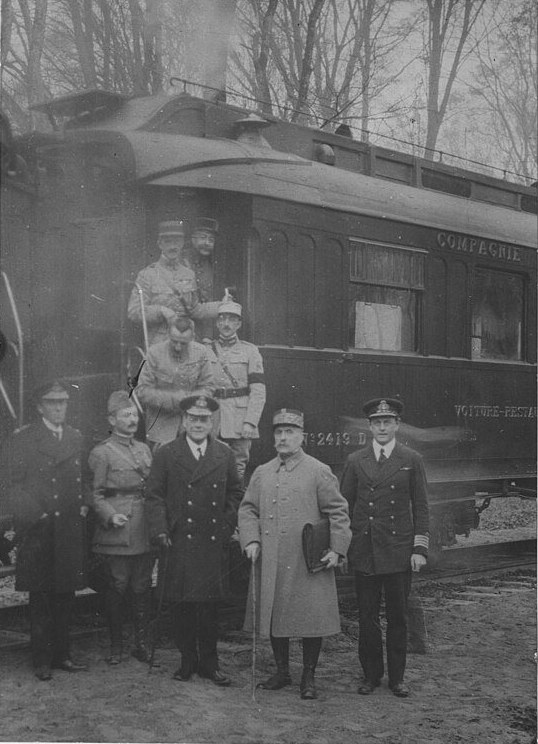
A little after five in the morning on November 11, 1918, a handful of men sat at a table inside a railway carriage in the Forest of Compiègne, north of Paris, and signed the document that ended the fighting on the Western Front. The carriage was a converted restaurant car, number 2419 D, and it belonged to Marshal Ferdinand Foch, the supreme commander of the Allied armies.
The armistice would take effect at 11 o'clock, Paris time. That gap of roughly six hours is the part of the story I find hardest to let go of, and I will come back to it.
First, the carriage, because it had a stranger life than most of the people in it.
Three days on a siding in the woods
The German delegation crossed the lines on the night of November 7 and reached the forest by train early on the 8th. It was led by Matthias Erzberger, a Catholic Centre Party politician rather than a general, which was a choice the German high command made on purpose and which would cost Erzberger dearly later.
Foch had parked his own train on one siding near the village of Rethondes. The Germans were put on another, a short walk away. There was not much negotiating in the usual sense. Foch, with the British First Sea Lord, Admiral Sir Rosslyn Wemyss, at his side, had the terms read out and gave the Germans 72 hours to accept them.
While the delegates sat in the woods, Germany came apart behind them. Sailors had mutinied at Kiel, revolution was spreading through German cities, and on November 9 Kaiser Wilhelm II's abdication was announced in Berlin. He crossed into exile in the Netherlands the next day. By the time Erzberger got word from home to sign, the government that had sent him no longer quite existed.
What Germany signed away
The terms were written to make sure Germany could not start fighting again. Its armies had to leave occupied France, Belgium, Luxembourg and Alsace-Lorraine within about two weeks. Allied troops would occupy the left bank of the Rhine. The British naval blockade stayed in place.
Then came the inventory, and it is long. Germany handed over thousands of artillery pieces and tens of thousands of machine guns, plus aircraft, locomotives, railway wagons and lorries. Its U-boats were to be surrendered and much of its surface fleet interned. Those ships ended up at Scapa Flow in Orkney, where their own crews scuttled most of them the following summer.
It was an armistice, a ceasefire, and not a peace treaty. It had to be renewed several times over the winter. The actual settlement with Germany, the Treaty of Versailles, was not signed until June 28, 1919.
The six hours after the signatures
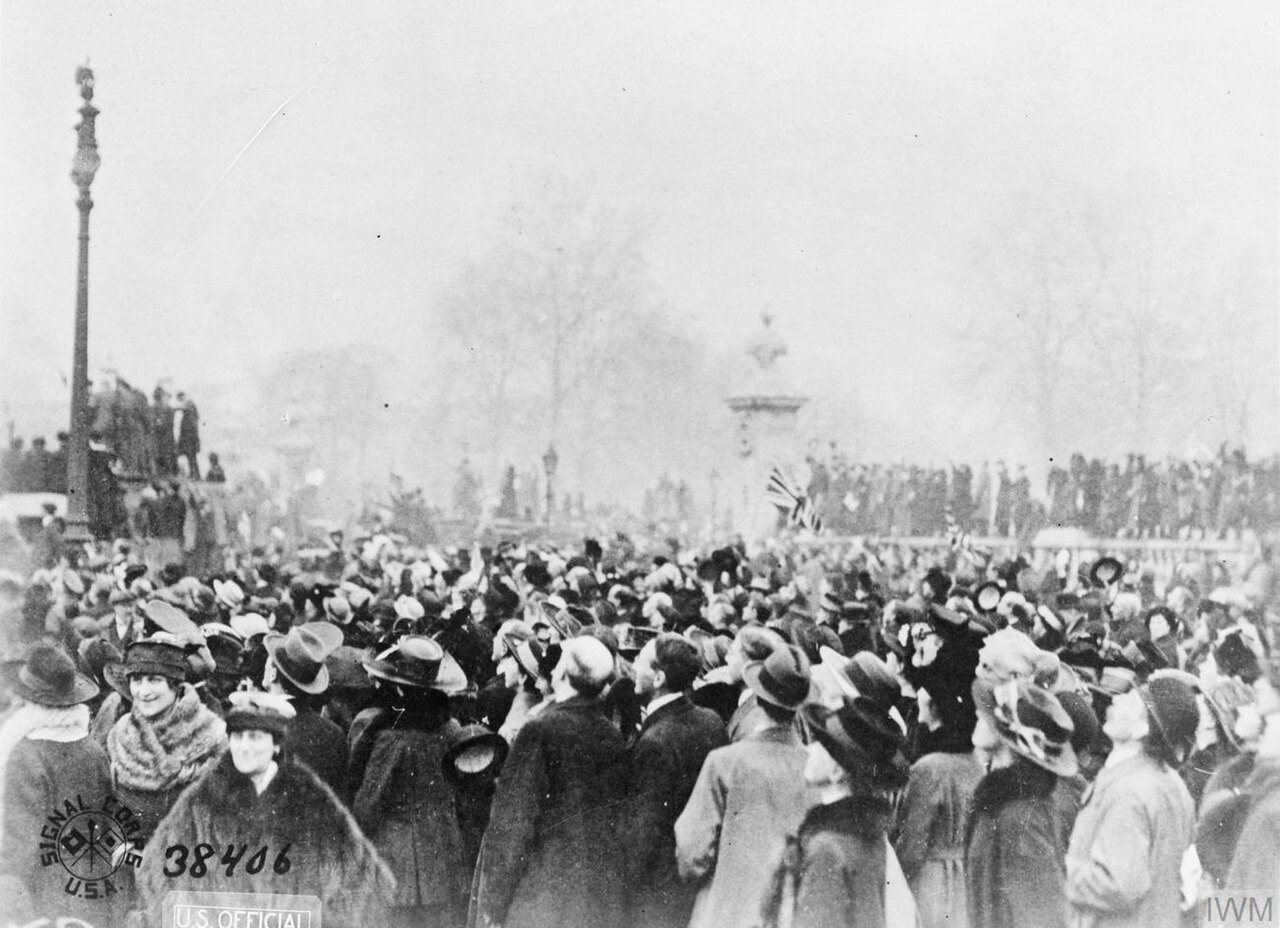
Crowds celebrating in London on Armistice Day, 11 November 1918. American official photographer, public domain, via Wikimedia Commons
The signing is usually given as about 5:10 or 5:20 a.m. The time chosen for the end of the war was 11 a.m., which made for a tidy phrase (the eleventh hour of the eleventh day of the eleventh month) and an untidy morning.
Word went out by radio and telephone, but the fighting did not stop when the ink dried. Some commanders held their positions and waited. Others kept attacking right up to the deadline, in some cases to take ground they would simply have walked onto a few hours later. Historians generally put the total casualties along the front that last day, killed, wounded and missing, in the thousands. I have seen several different totals and I don't trust any of them to the last digit, but nobody disputes the scale.
A few of the names have stuck. George Ellison, a British private who had been at Mons in 1914, was killed near Mons that morning. The Canadian private George Price was shot by a sniper at about 10:58. Henry Gunther, an American sergeant from Baltimore, charged a German machine-gun post at around 10:59, and the Germans, who reportedly tried to wave him back, opened fire. He is usually counted as the last American soldier killed in the war.
Then it was 11 o'clock, and the guns stopped.
In London, Paris and New York, people poured into the streets. On the front itself, many soldiers remembered the silence more than anything else.
The carriage that came back
The French treated carriage 2419 D as a relic. It went on display in Paris and then, in 1927, was brought back to the clearing at Rethondes and housed in a memorial building there, near a granite slab marking where it had stood.
Which is why, in June 1940, Adolf Hitler insisted that France sign its own armistice in the same carriage, at the same spot. German engineers pulled it out of its building and set it back on the old siding for the occasion. Afterwards it was taken to Germany as a trophy, and it was destroyed near the end of the Second World War. Exactly how and by whom is still argued about, so I will leave it there.
Matthias Erzberger did not survive long either. Nationalists blamed the men who had signed for "stabbing Germany in the back," a myth that helped poison the Weimar Republic, and Erzberger was murdered by right-wing extremists in 1921.
Remembering it today
The clearing is still there, a few miles east of Compiègne, and the site has a museum with a carriage from the same series fitted out to look like Foch's, with the table and the chairs where the delegates sat. If you are anywhere near Paris it is an easy half-day, and quieter than you might expect.
At 11 a.m. today, people in Britain and much of the Commonwealth will stand for two minutes of silence, a custom that began on the first anniversary in 1919. France marks it as a national holiday. In the United States, Armistice Day became Veterans Day in 1954. The ceremonies differ from country to country, but most of them still use 11 o'clock, the hour Foch's staff picked in a railway carriage while it was still dark outside.
Enjoyed this story?Get a new one every day on social.