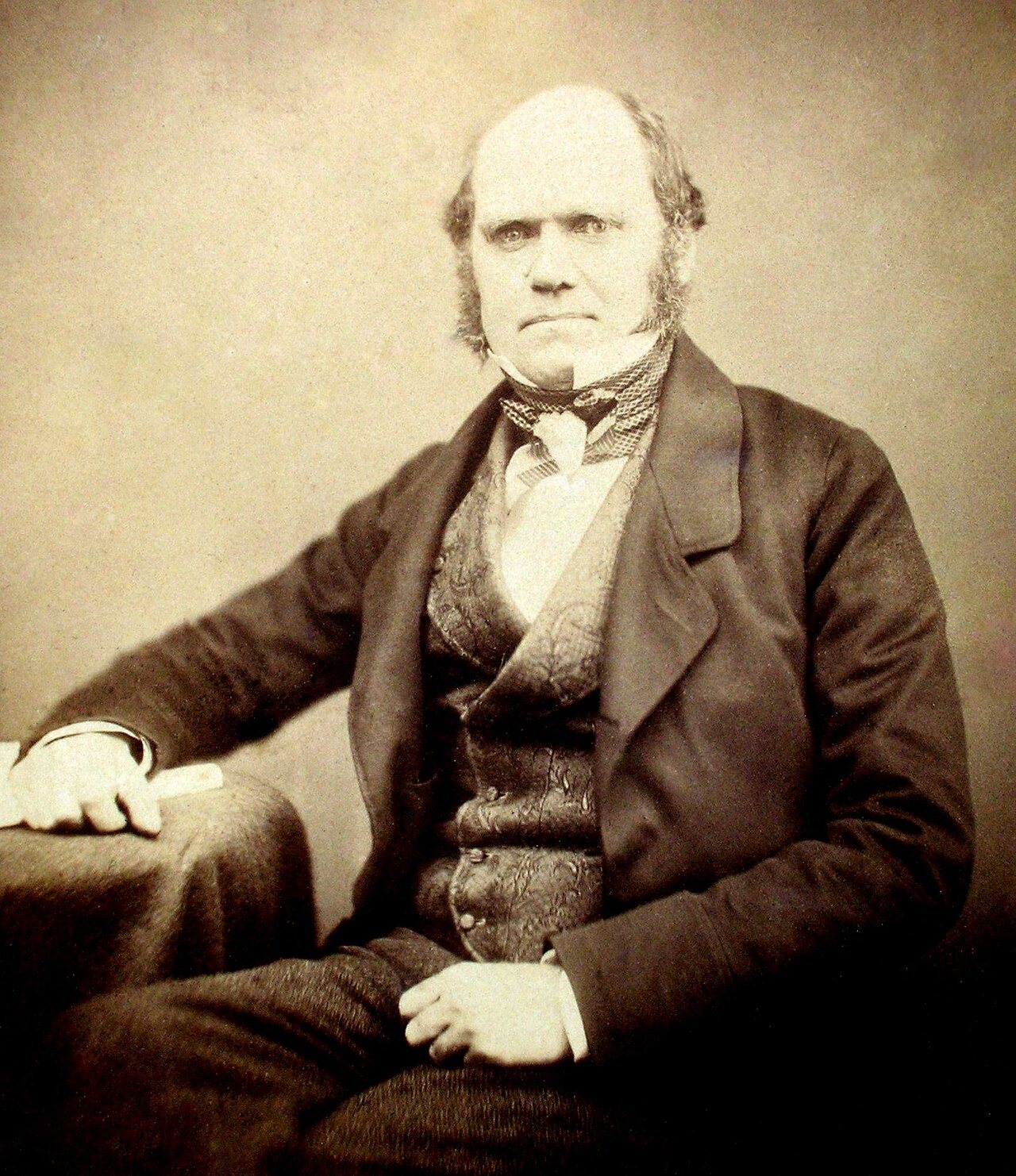
Photo: Maull and Polyblank, public domain, via Wikimedia Commons
On Thursday, November 24, 1859, the London publisher John Murray put out a green cloth book with a very long title: On the Origin of Species by Means of Natural Selection, or the Preservation of Favoured Races in the Struggle for Life. It cost 15 shillings, which was not cheap.
Murray had printed about 1,250 copies. By the official publication date they were already spoken for, because booksellers had ordered the whole run at Murray's trade sale two days earlier. A second printing of 3,000 followed within weeks.
The author was a 50-year-old naturalist who rarely left his house in Kent and who, for most of the previous two decades, had told almost nobody what he was working on. Charles Darwin regarded the book as a rushed summary, and he wasn't just being modest: he had meant to write something much longer.
Twenty years in a drawer
Darwin came home from the five-year voyage of HMS Beagle in October 1836 with crates of specimens and a head full of questions about why species looked the way they did on islands like the Galapagos. In July 1837 he opened a private notebook on the "transmutation" of species. A page in it carries a small branching sketch with the words "I think" written above it. For the opening move of a scientific revolution, that is a pretty hesitant start.
By 1842 he had a short pencil sketch of the theory, and by 1844 an essay of a couple of hundred pages. That year he wrote a letter to his wife, Emma, asking her to make sure the essay was published if he died, and setting aside money for an editor. Then he put it away.
What he did next was spend roughly eight years on barnacles. It sounds like procrastination (and I admit that was my first reaction), but the barnacle monographs gave him a reputation as a careful taxonomist, and that standing mattered a great deal when he finally went public with something far more dangerous.
A letter from the other side of the world
In 1856, nudged by his friend the geologist Charles Lyell, Darwin started on a big book he called Natural Selection. He was perhaps halfway through it when, in June 1858, a letter arrived from Alfred Russel Wallace, a collector working in the Malay Archipelago. Wallace enclosed a short essay and asked Darwin to pass it on to Lyell if he thought it worthwhile.
The essay described, in outline, the same mechanism Darwin had been sitting on since the late 1830s. Darwin wrote to Lyell that he had never seen a more striking coincidence.
Lyell and the botanist Joseph Hooker arranged a compromise. On July 1, 1858, Wallace's essay and extracts from Darwin's earlier writings were read together at a meeting of the Linnean Society in London. Neither author was there. Wallace was still abroad and did not know about it until later, and Darwin was at home after the death of his infant son a few days before.
The reaction was close to nothing. The society's president, Thomas Bell, later remarked that the year had not been marked by any of the striking discoveries that revolutionize a field of science. Historians have enjoyed quoting that line back at him ever since.
Thirteen months of writing an "abstract"
Darwin abandoned the big book and set out to write a condensed version, which he kept calling his abstract. It took him about 13 months and ran to nearly 500 pages, so his idea of an abstract was generous.
Murray agreed to publish without reading much of it. Whitwell Elwin, the editor Murray asked for an opinion, is said to have suggested Darwin drop the theory and write about pigeons instead, since everyone was interested in pigeons. To be fair to Elwin, Darwin did keep pigeons, and the book opens with a long chapter on breeding under domestication, pigeons very much included.
What the first edition does and doesn't say
A few things in the 1859 text surprise people. The word "evolution" does not appear in it at all. The very last word of the book is "evolved," in the closing passage about endless forms most beautiful. Darwin preferred "descent with modification" and only used "evolution" in the sixth edition, in 1872.
"Survival of the fittest" isn't there either. That phrase came from the philosopher Herbert Spencer, and Darwin added it in the fifth edition of 1869.
The book has exactly one illustration, a fold-out diagram of branching lines showing how species might diverge from common ancestors over time. And it says almost nothing about humans. There is one sentence near the end predicting that light will be thrown on the origin of man and his history. Darwin waited until The Descent of Man in 1871 to say more, though readers in 1859 had no trouble working out where the argument led.
The argument that followed
The response was loud and quick. Reviews ranged from admiring to furious, and Darwin's own former teachers were among the critics. The best remembered clash came at Oxford on June 30, 1860, during a meeting of the British Association, when Bishop Samuel Wilberforce and the biologist Thomas Henry Huxley exchanged words. The famous version, in which Wilberforce asks Huxley whether he descends from an ape on his grandmother's or grandfather's side, comes from accounts written down years later, and they do not agree with one another. Something sharp was clearly said, but nobody can be sure exactly what.
Darwin, who disliked public fights, stayed home and revised. He put out six editions in his lifetime, changing the text substantially as critics pushed on its weak points. The biggest gap was heredity, since nobody in 1859 knew how traits were passed on. That had to wait for genetics in the next century.
Reading it yourself
The first edition is easier to read than its reputation suggests, and you don't need a rare book dealer to do it. The full text of every edition is free on Darwin Online, and the Darwin Correspondence Project has published his letters, including the anxious ones from June 1858. If you are ever near Downe in Kent, Down House, where he wrote the book, is run by English Heritage and you can walk the sandwalk path he used for thinking. I would start with the final chapter, where his prose finally relaxes.
Enjoyed this story?Get a new one every day on social.