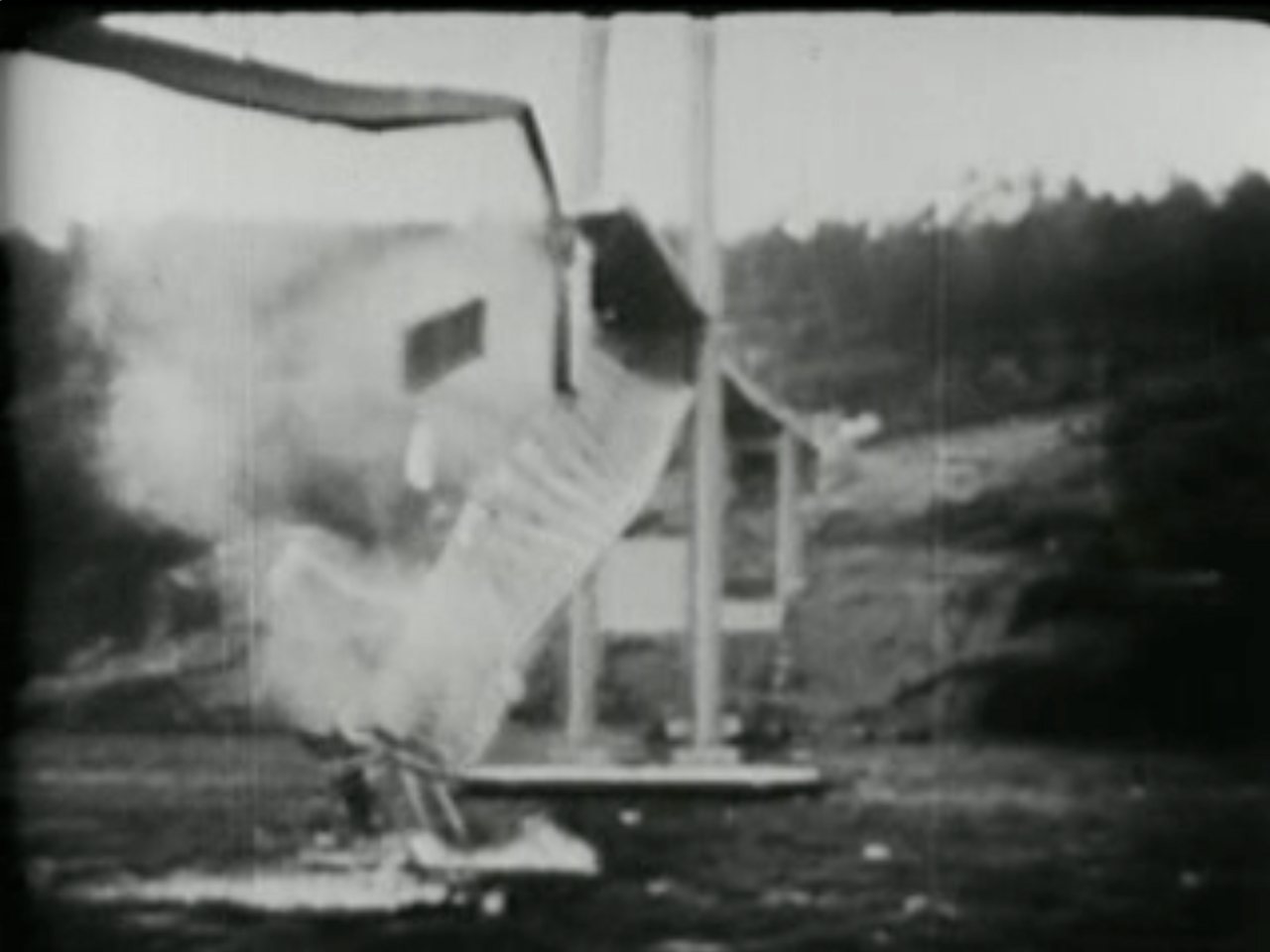
Barney Elliot, Public Domain, via Wikimedia Commons
A little after 11 o'clock on the morning of November 7, 1940, the middle of the Tacoma Narrows Bridge tore loose and dropped into Puget Sound. The bridge had been open for four months and seven days.
Nobody who saw it needed a newspaper to tell them what happened, because a local camera shop owner named Barney Elliott was standing at the end of the span with a film camera. His footage, the deck heaving and corkscrewing before it finally lets go, is probably the most watched clip in the history of civil engineering. If you sat through a physics or engineering class, there is a fair chance somebody wheeled in a projector and showed it to you.
What gets lost in the clip is how ordinary that morning was supposed to be, and how many people had already noticed that the bridge moved.
A bridge the workers nicknamed before it opened
The Tacoma Narrows Bridge linked Tacoma with the Kitsap Peninsula across a strait about a mile wide. When it opened on July 1, 1940, its center span of 2,800 feet made it the third-longest suspension bridge in the world, behind the Golden Gate and the George Washington.
It was also remarkably thin. Washington State's own engineer, Clark Eldridge, had drawn up a design with a deck stiffened by 25-foot-deep trusses. The federal money came with a cheaper plan from Leon Moisseiff, a respected New York engineer who had worked on the Manhattan Bridge and consulted on the Golden Gate. Moisseiff replaced the trusses with solid plate girders only 8 feet deep. The result was elegant, slim and a lot less expensive. It was also, for a span that long, very flexible.
The construction crews felt it first. In a moderate wind the deck rose and fell in long waves, enough that workers started calling the bridge Galloping Gertie. After it opened, drivers came out on purpose to ride the bounce, which tells you something about 1940 and something about people in general.
Forty miles an hour and a dog named Tubby
The engineers were worried enough to bring in Professor Frederick Burt Farquharson of the University of Washington, who built a scale model and studied the motion. Hold-down cables and other fixes were tried over the summer. None of them settled Gertie down for long.
On November 7 the wind through the Narrows was blowing at roughly 40 miles an hour. That is a stiff breeze, not a storm. The deck was doing its usual up-and-down galloping in the morning, and then the motion changed. One side of the roadway rose while the other dropped, and the whole deck began twisting along its centerline, tilting back and forth like a ribbon held at both ends.
Leonard Coatsworth, an editor at the Tacoma News Tribune, was driving across when the twisting started. His car was thrown around badly enough that he abandoned it and crawled back to the tower on his hands and knees. His daughter's cocker spaniel, Tubby, was still in the car. Farquharson, who was on the bridge to observe, tried to reach the dog, and Tubby, terrified, bit him. Farquharson had to give up.
The bridge was closed to traffic before the end. When the deck finally broke and fell, it took Coatsworth's car and Tubby with it. Tubby was the only life lost. I have read a lot of disaster stories for this job, and I still find it hard to get past that detail.
What actually brought it down
For decades the standard explanation, the one in a lot of textbooks, was resonance: the wind pushed at the bridge's natural frequency, the way a singer is supposed to shatter a glass. It is a tidy story. It is also not quite right, and engineers have been complaining about it for years. (A 1991 paper by K. Yusuf Billah and Robert Scanlan in the American Journal of Physics is the one usually cited by people who want to correct their old teachers.)
The better description is aeroelastic flutter. Once the deck started twisting, the twisting itself changed how the wind flowed over and around it, and that change fed energy back into the twist. The motion was not being driven by a steady wind matching some magic frequency. The bridge's own movement was pulling more energy out of the wind with each cycle until the structure gave way. The shallow, solid girders made it worse, because they presented a flat face to the wind instead of letting air pass through the way an open truss does.
A federal board of review that included Othmar Ammann and Theodore von Kármán reported in 1941. Its findings pushed bridge design toward aerodynamics, and wind tunnel testing became routine for long suspension spans.
The bridge that replaced it
The war got in the way of a quick rebuild, and the replacement did not open until October 1950. It had deep, open stiffening trusses, much closer to what Eldridge had proposed in the first place, and it had been tested in a wind tunnel before anyone poured concrete. That bridge still carries traffic today. A second, parallel span opened in 2007 to handle the load in the other direction.
As for Gertie, most of the fallen deck is still down there. The wreckage became an artificial reef, and in 1992 it was listed on the National Register of Historic Places, partly to keep salvagers away from it. It is a protected dive site now, which is not a bad retirement for a bridge that only worked for four months.
Why the clip still matters
Elliott's film was added to the National Film Registry in 1998, alongside feature films, which feels fair. Few movies have changed as many minds.
If you want to see it, the full footage is easy to find and only a few minutes long. Watch it twice. The first time you will watch the collapse. The second time, watch the lamp posts along the deck and the way the far end tilts while the near end doesn't. That twisting is what the engineers in 1941 were trying to understand, and it is why the replacement went into a wind tunnel before it went across the Narrows.
Enjoyed this story?Get a new one every day on social.