Photo: Allen Stross, public domain, via Wikimedia Commons
Before November 1, 1968, if you wanted to know whether a movie was fit for your twelve-year-old, you read the reviews or asked a neighbor who had already seen it. After that date, the answer was printed right on the poster in a single letter.
The new system came from the Motion Picture Association of America and its president, Jack Valenti, who had announced it a few weeks earlier, on October 7. It had four grades. G meant general audiences. M meant mature audiences, with parents left to decide. R meant restricted: under-16s needed a parent or adult guardian with them. X meant nobody under 16 got in at all.
I grew up assuming those letters had always been there, like the popcorn machine. They hadn't. They were Hollywood's answer to a rulebook that had stopped working.
The old rulebook that kept everything "suitable"
For more than three decades, American studios had policed themselves through the Production Code, often called the Hays Code after Will Hays, the industry's chief spokesman when it was adopted in 1930. It was enforced in earnest from 1934, when Joseph Breen took charge of the office that gave films their seal of approval.
The Code didn't sort movies by audience. It simply assumed every film should be fit for everyone, and it spelled out what could and couldn't be shown, down to the rule that crime had to be punished by the last reel and a list of words nobody could say. A film without the seal had a hard time getting into the big theater chains, so the studios mostly played along.
That is a big part of why films of the 1940s and early 1950s feel the way they do, with married couples in twin beds and most of the interesting stuff happening just off screen. Audiences got very good at reading between the lines.
How the Code wore thin in the 1950s and 1960s
The cracks started in 1952, when the Supreme Court ruled in Joseph Burstyn, Inc. v. Wilson (the "Miracle" case, named for the Roberto Rossellini film at its center) that movies were protected by the First Amendment. States and cities could no longer ban films quite so freely, and a seal from the industry's own censors started to look less necessary.
A year later, Otto Preminger released The Moon Is Blue without a seal after refusing to cut the words "virgin" and "pregnant." It made money anyway. By the mid-1960s the exceptions were piling up. Warner Bros. released Who's Afraid of Virginia Woolf? in 1966 with a "Suggested for Mature Audiences" tag, and MGM put out Blow-Up that same year through a subsidiary rather than cut it to win approval.
Valenti took over the MPAA in 1966, and he reportedly found the Code impossible to defend. Meanwhile the courts were signalling that what was acceptable for adults might not be acceptable for children, which pointed toward exactly the kind of age-based grading that arrived in 1968.
What G, M, R and X looked like in practice
The genius of the new scheme, if you can call it that, was that it stopped trying to decide what adults could watch. It only told parents what they were walking into. Theater owners, through their national association, agreed to enforce the age limits at the box office, which is a polite way of saying that a teenager at the ticket window now had to look convincingly older.
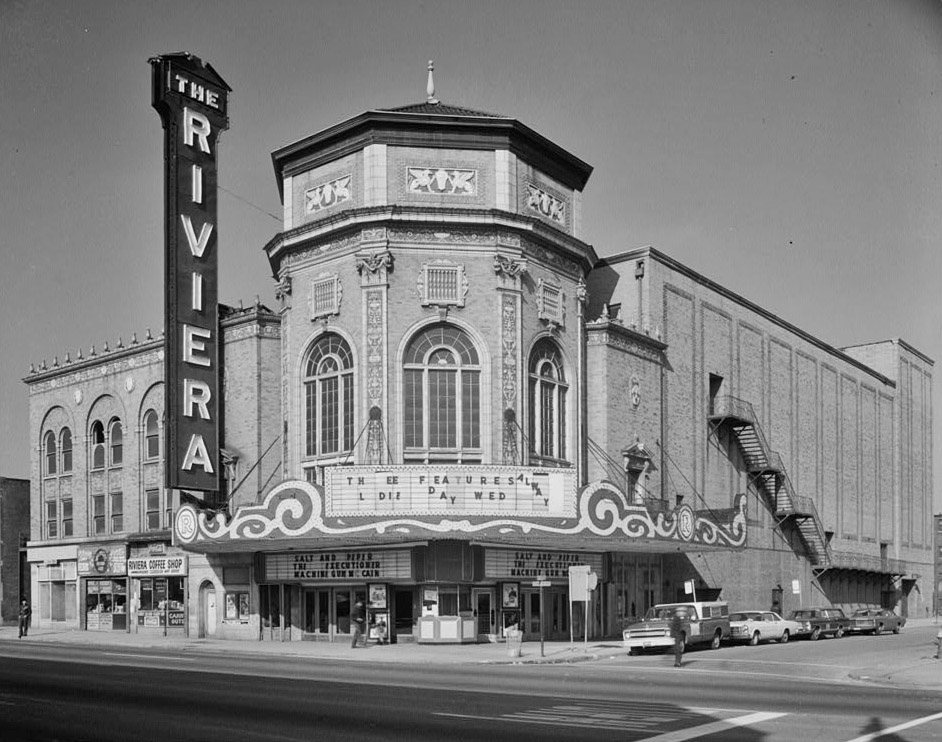
The photo at the top shows the Riviera in Detroit in 1970, about the time all this was settling in. The marquee lists Salt and Pepper, a 1968 crime comedy with Sammy Davis Jr. and Peter Lawford. I'd love to know how many kids talked their way in on a Saturday afternoon. (I suspect quite a few. Box office staff were not famous for checking.)
One quirk turned out to matter a great deal. The MPAA trademarked G, M and R but not X, so any distributor could slap an X on a film without submitting it at all. Within a few years the letter was mostly associated with adult theaters, and serious filmmakers wanted nothing to do with it.
The X that won Best Picture
Before that happened, though, X had one strange moment of respectability. Midnight Cowboy, released in 1969 with an X rating, won the Academy Award for Best Picture. It remains the only X-rated film ever to do so. It was later re-rated R, which tells you how quickly the meaning of the letter shifted.
The other letters shifted too. The R and X age limit moved up from 16 to 17 in 1970. M confused people (plenty of parents read it as stricter than R), so it became GP that same year and then PG in 1972.
PG-13 and NC-17: the letters keep moving
The biggest change came in 1984, after parents complained about the violence in two PG releases, Gremlins and Indiana Jones and the Temple of Doom. That summer the MPAA added PG-13, and Red Dawn became the first film released with it. Steven Spielberg, who had a hand in both of the films that started the fuss, is usually credited with suggesting the new category.
X finally gave way in 1990, replaced by NC-17, a rating the MPAA could control. Henry & June was the first film released with it. NC-17 never really escaped the old stigma, though; many theaters and newspapers still wouldn't touch those films, and the rating stays rare.
Reading the box on a poster today
The system is still voluntary, still run by a board of parents, and the organization behind it now goes by the shorter name Motion Picture Association. What has changed most is the small print. Since the early 1990s most ratings come with a brief line explaining them, such as "for violence and some language." I find that line more useful than the letter itself. Two R-rated films can be very different evenings, and the reason tells you which kind you've got.
So if you're picking something for a family movie night this month, glance at the letter and then read the sentence underneath it before you buy the tickets.
Enjoyed this story?Get a new one every day on social.