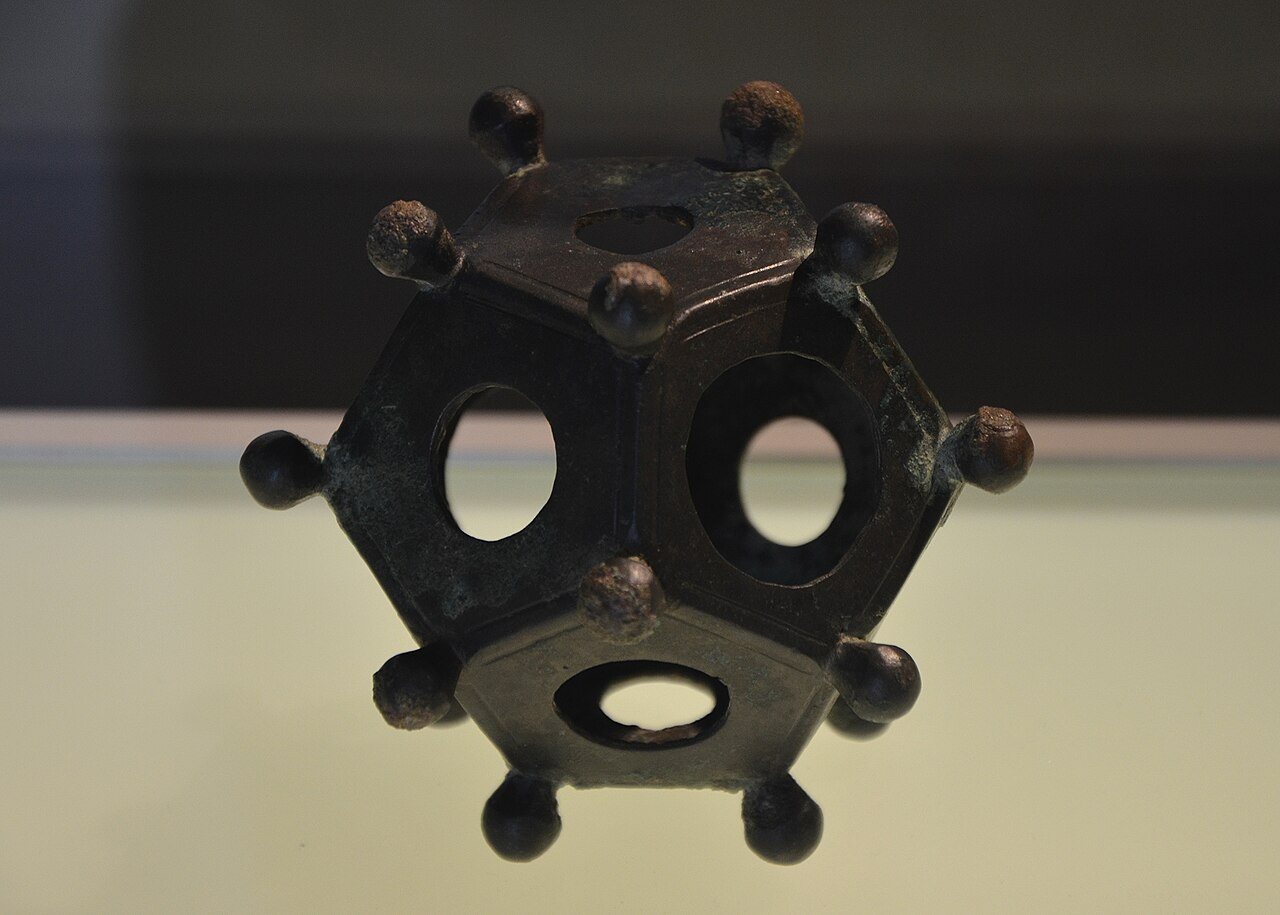
Photo: Carole Raddato, CC BY-SA 2.0, via Wikimedia Commons
Picture a hollow bronze ball that isn't quite a ball. It has twelve flat pentagonal faces, a round hole cut through each one, and a small knob soldered onto every corner. It would sit comfortably in your palm. Nobody living knows what it was for, and as far as anyone can tell nobody in the Roman world thought it worth writing down.
These objects are called Roman or Gallo-Roman dodecahedra. Somewhere over a hundred of them have turned up, with most estimates sitting around 130, and they date from roughly the second to the fourth centuries AD. Not one Roman author mentions them, and no surviving image shows one in use.
Most baffling artifacts are baffling because they are broken or because we've lost the context around them. These are often in beautiful condition, and we still have no idea.
What the objects look like up close
The bodies range from about 4 to 11 centimeters across. The lightest known example weighs 35 grams and the heaviest a full kilogram, which is a big spread for something that is supposedly one type of thing. They were cast in copper alloy by the lost-wax method, a slow and skilled way of working, and the outsides were finished with care and probably polished. The insides were left rough.
The holes are where it gets strange. They vary from one face to the next on the same object, anywhere from 6 to 40 millimeters across, with no standard pattern from piece to piece. Rings and dots often decorate the faces. The knobs at the corners are irregular, which suggests each was made by hand and not from a mold. And there are no letters or numbers on any of the bronze examples, which is frustrating, because a single scratched word would probably have ended this argument two centuries ago.
They also show very little wear. Whatever these were for, it wasn't hard daily use.
Where they turn up, and where they don't
The first recorded example was presented to the Society of Antiquaries of London on June 28, 1739, and was reported to have come from a field at Aston in Hertfordshire. Since then they have appeared in Britain, France, Germany, Belgium, the Netherlands, Luxembourg, Switzerland, Austria and Hungary. Britain alone has more than thirty.
The distribution is the single best clue we have. They cluster in the northwestern provinces and on the frontier, and none has been found in Italy, the heart of the empire. That makes it likely this was a Gallic or northern habit and not a Roman one, and most were probably made in Gaul.
Their findspots don't help as much as you'd hope. Where the context is known, it is often military or funerary, but others have come from baths, a theater, a riverbed and a coin hoard. That last one matters a little: people hid these alongside their money, so somebody thought they had value.
More than fifty explanations, and the trouble with each
Scholars have published over fifty proposals. A few of the better-known ones give a fair idea of how the debate goes.
An early favorite was a weapon of some kind, a mace head or a sort of bullet. Most of them are too light for that, and a mace head wouldn't need twelve carefully different holes.
A surveying or rangefinding tool sounds clever, since you could in theory sight through paired holes to judge a distance. But an instrument needs marks, and these have none. Sizes aren't standardized either.
A gauge for checking coins has been suggested by Bernhard Greiner, the idea being that the holes could test a coin's diameter and catch clipping. It would explain the hoard, though not the knobs.
Then there is my favorite, the knitting theory. Hobbyists have shown you can use a dodecahedron as a spool to knit gloves, and the videos are charming. I'd love it to be true. The earliest known reference to spool knitting, however, dates from 1535, and bronze cast by lost wax seems a rather expensive way to make a glove.
Other proposals include a child's toy, a calendar for timing the sowing of crops, and a test piece, a showpiece that a metalsmith made to prove his skill. That last one has more going for it than most, given the cost of the bronze and the difficulty of the casting, but it doesn't explain why customers wanted to keep them.
The silver one with the zodiac on it
One object nudges the argument toward religion or fortune-telling. In 1982 a silver dodecahedron was found at Geneva with the names of the signs of the zodiac engraved on its twelve faces. A twelve-sided object and a twelve-part sky make a neat pairing, and classical philosophy took the shape seriously (Plato linked it with the cosmos itself).
So a good many specialists now lean toward some ritual or divinatory use, especially as most finds come from Gallo-Roman sites. I lean that way too, on a modest scale. I should add that it is the sort of answer archaeologists reach for when they run out of practical ideas, and we know it.
The Lincolnshire find that revived the argument
In 2023 volunteers from the Norton Disney History and Archaeology Group were metal detecting during a dig in Lincolnshire when they came up with a dodecahedron about the size of a grapefruit. It was intact, in excellent condition, and bigger than most. Richard Parker, the group's secretary, called it "the find of a lifetime." It's hard to argue with him. Very few volunteers ever get to hold something that the entire profession can't explain.
The object was featured on the BBC series Digging for Britain, and when it went on public display in 2024, more than 15,000 people came to see it. I'd bet a fair few of them walked out with a theory.
If you want to try for yourself, museums across northwestern Europe hold examples, and Britain's are spread through regional collections. Look at the holes first, then the knobs. I wouldn't expect to solve it, though I'd be delighted to be wrong.
Enjoyed this story?Get a new one every day on social.