Photo: Joyofmuseums, CC BY-SA 4.0, via Wikimedia Commons
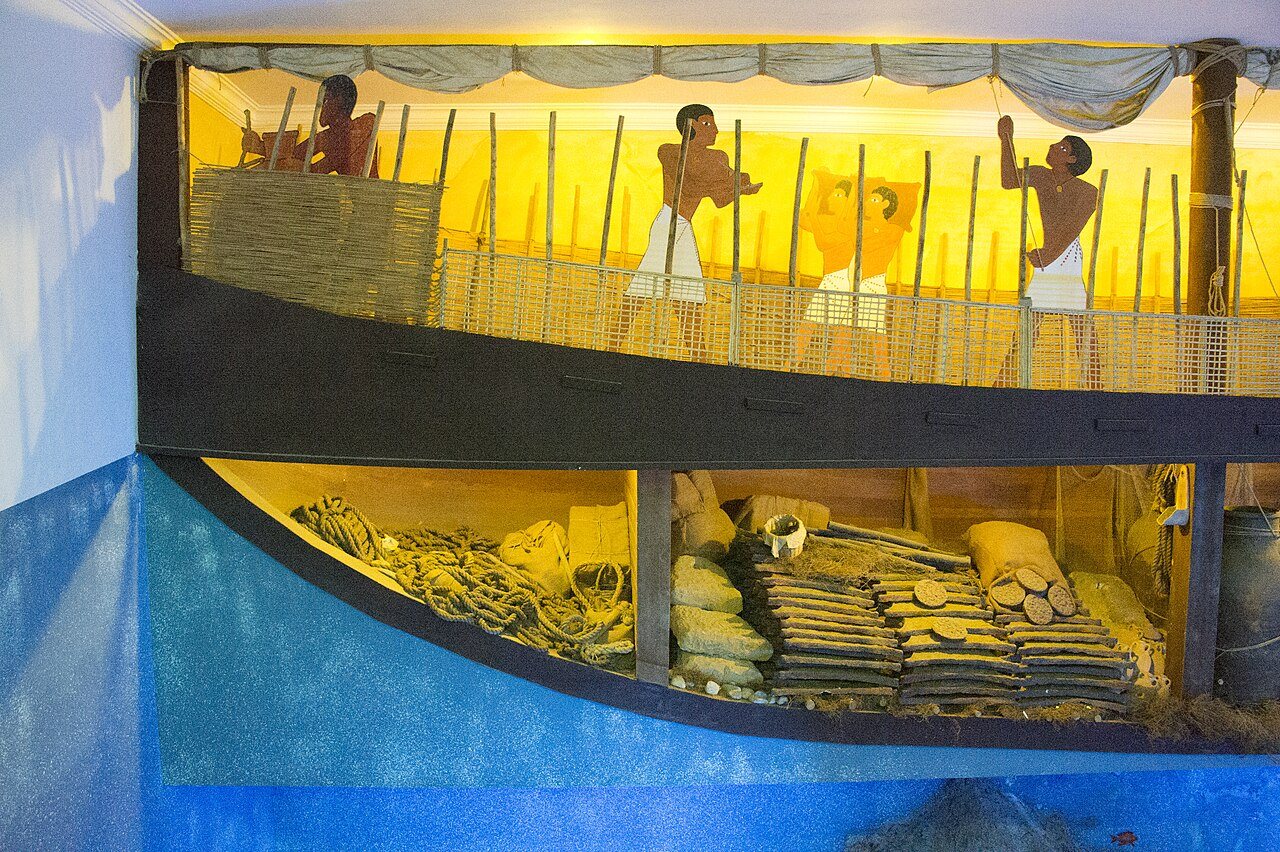
In the spring of 1900 a crew of sponge divers from the island of Symi was waiting out a storm off Antikythera, a scrap of rock between Kythera and Crete. When the weather cleared, one of them went down and came back up shaken. As the story is usually told, he described a seabed covered in bodies and horses. They were bronze and marble statues, lying on the remains of a ship that had sunk about two thousand years earlier.
The Greek government organised a salvage the following winter, with navy support and those same divers working at depths that were frankly dangerous for the equipment of the day. At least one diver died and others were left injured. What they brought up filled galleries at the National Archaeological Museum in Athens: a life-size bronze youth, marble figures, glassware, pottery. A few lumps of corroded bronze and wood went into storage with everything else, and nobody paid them much attention.
The gear wheel nobody expected
In May 1902 the archaeologist Valerios Stais was looking over the finds and noticed something odd in one of those lumps. As the wood dried out and the pieces split, a toothed wheel showed through the corrosion. Gears were not what anyone expected from a ship of that age.
Stais suggested it might be an astronomical device. Plenty of his colleagues thought it had to be later, perhaps something that had fallen onto the wreck from a much younger ship. That doubt is easy to understand. The ship itself is usually dated to the first half of the first century BC (roughly 70 to 60 BC, going by the pottery and coins), and the idea of fine bronze gearing from that period simply did not fit what scholars thought the Greeks could make.
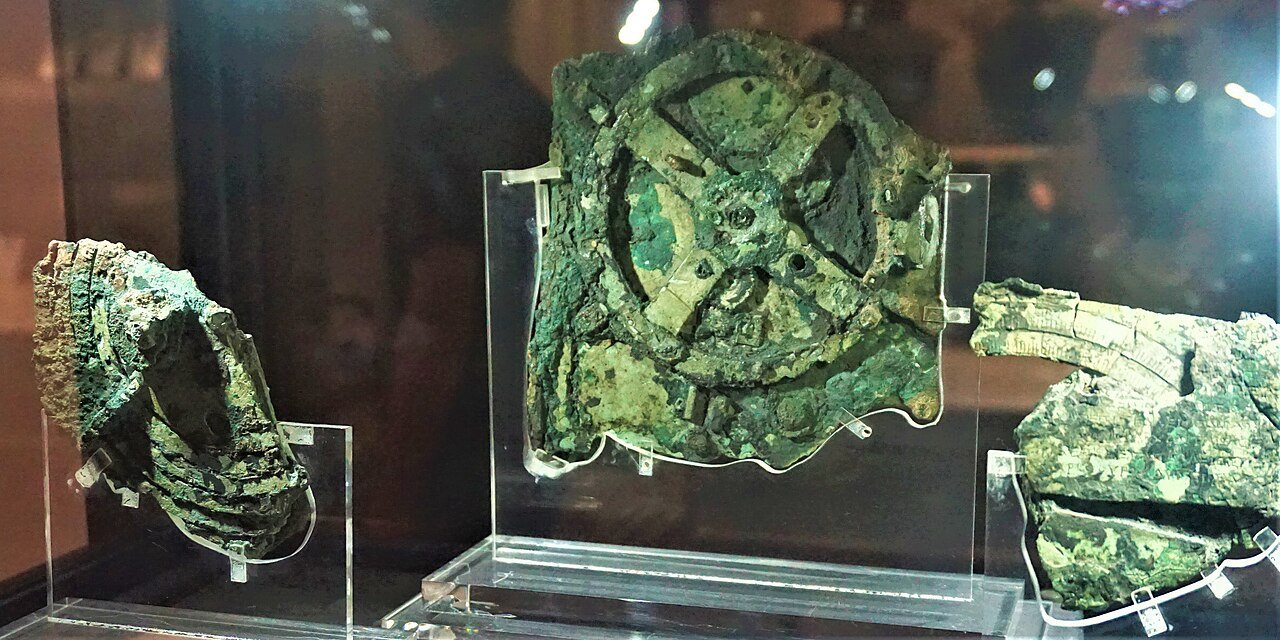
Today the surviving pieces number 82 fragments, with about 30 gears still identifiable inside them. When it was whole, the machine sat in a wooden case about the size of a shoebox, with dials on the front and back and a hand crank on the side.
How the X-rays changed the argument
For most of the twentieth century the mechanism was a puzzle for a handful of specialists. The big step came from Derek de Solla Price, a historian of science at Yale, who worked with the Greek radiographer Charalambos Karakalos to image the fragments. Price published his reconstruction in 1974 under the title "Gears from the Greeks." He got a fair amount wrong, as later work showed, but he established beyond much argument that this was a calculating machine built to model the sky.
Michael Wright, then a curator at the Science Museum in London, spent years after that rebuilding the gear trains and arguing that the front once showed the planets as well as the Sun and Moon.
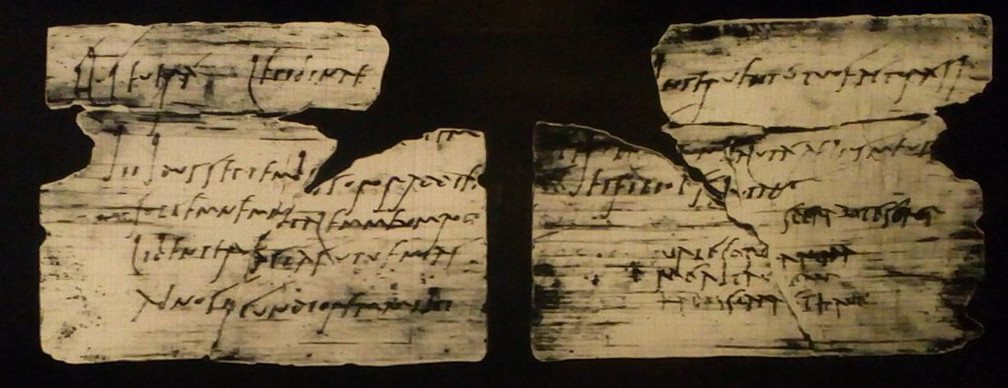
Then in 2005 the Antikythera Mechanism Research Project brought in high-resolution X-ray CT scanning and surface imaging. Their results, published in Nature in 2006, did two things. They mapped the gearing in far more detail, and they revealed thousands of characters of Greek text hidden inside the fragments. Much of that text is a set of instructions and labels, which is about as close as the ancient world gets to a user manual.
What it actually calculated
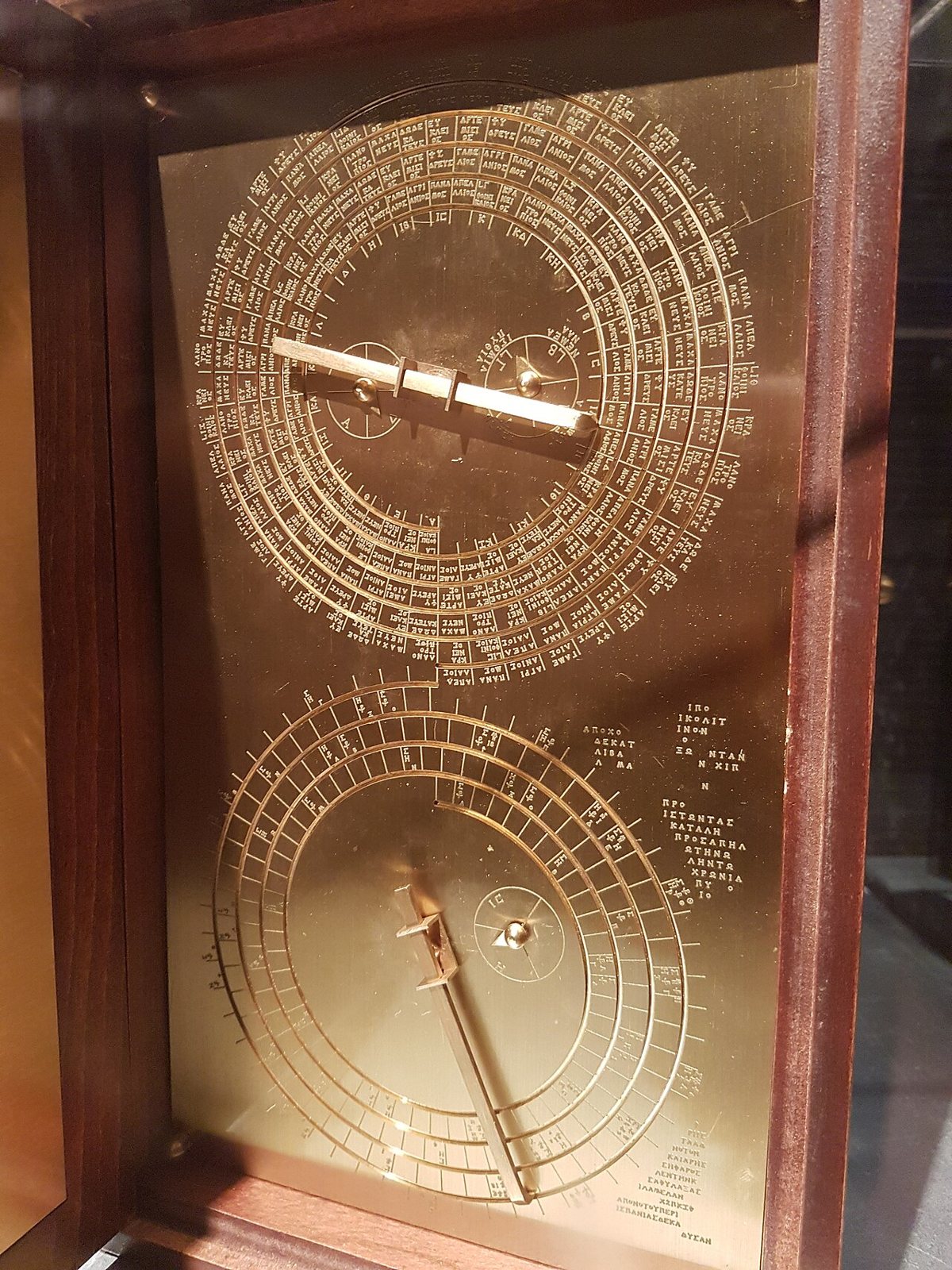
Modern brass reconstruction of the back of the mechanism, with the Metonic spiral dial above and the Saros eclipse dial below. Photo: Gts-tg, CC BY-SA 4.0, via Wikimedia Commons
Turn the crank and the front dial moved pointers for the Sun and Moon through the zodiac, alongside the 365-day Egyptian calendar used by Greek astronomers. A small ball, half pale and half dark, rotated to show the phase of the Moon.
The back was where it got clever. A spiral dial tracked the 19-year Metonic cycle, after which lunar months and solar years line up again (235 months fit almost exactly into 19 years). A second spiral counted the 223-month Saros cycle used to predict eclipses, with glyphs marking which months would bring one. A smaller dial, identified in a 2008 paper, kept track of the four-year cycle of the Panhellenic games, including the Olympics.
My favourite detail is the Moon. The Moon does not move across the sky at a steady speed, and the makers knew it. They modelled the change with a pair of gears joined by a pin sliding in a slot, so the Moon pointer sped up and slowed down over the month. The theory behind that motion is associated with the astronomer Hipparchus, who worked in the second century BC.
Who could have built it
Nobody knows, and I would be suspicious of anyone who claims to. The inscriptions use month names that scholars have linked to Corinth and its colonies, which has led some to look toward Syracuse in Sicily, Archimedes' home city. Others point to Rhodes, where Hipparchus worked for a time and where the philosopher Posidonius later ran a school.
There is a nice piece of literary evidence here. Cicero wrote about a bronze sphere made by Archimedes that showed the motions of the Sun, Moon and planets, brought to Rome after the sack of Syracuse. In another work he mentions a similar device made by Posidonius. Neither passage describes our machine, but both tell us that educated Romans knew such things existed.
The date of the mechanism is also argued over. Most estimates put its making in the second century BC, and one study has proposed that the eclipse dial starts in 205 BC. That would make the device a good century older than the ship it sank with.
A front panel still under construction
The planetary display on the front is the part most open to debate, because almost none of it survives. In 2021 a team at University College London published a new reconstruction in Scientific Reports, fitting the five planets known in antiquity into a compact arrangement of rings and gears consistent with the inscriptions. They called it a model, not a final answer, which is the right attitude.
What is not really in dispute is how unusual the thing is. Nothing with gearing of comparable complexity survives again until the astronomical clocks of medieval Europe, well over a thousand years later. That gap is the most interesting part of the whole story to me. Either a tradition of fine instrument making was lost, or its products were melted down for their bronze and simply have not survived. I lean toward the second, though I would love to be proved wrong by another wreck.
Seeing it for yourself
The original fragments are on display at the National Archaeological Museum in Athens, together with modern reconstructions that show the dials working. The largest fragment, with its four-spoked wheel, is smaller than most visitors expect, so give yourself time to look closely.
The research papers from 2006 and 2021 are both free to read online, and the 2021 one includes readable diagrams for non-specialists. Divers have also returned to the wreck site in recent years under a Greek and Swiss team, and the seabed off Antikythera is still producing finds. It took two years for anyone to notice the first gear, so I would not assume the story is finished.
Enjoyed this story?Get a new one every day on social.