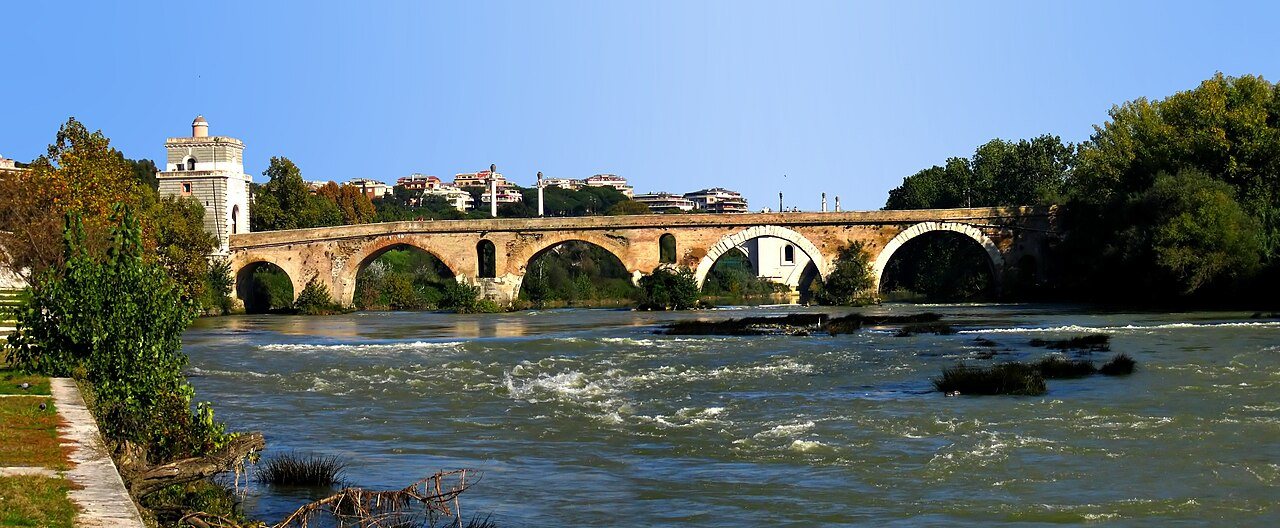
Photo: Anthony Majanlahti, CC BY 2.0, via Wikimedia Commons
On the morning of October 28, 312, Maxentius did something that surprised everyone who knew him. He left Rome. For six years he had held the city behind the Aurelian Walls, and walls had served him well; two earlier invasions by rival emperors had stalled in front of them. Yet with Constantine's army camped to the north, he marched his troops out across the Tiber to fight in the open.
By evening Maxentius was dead in the river, and Constantine was the master of Rome. The fight took its name from the Milvian Bridge, a stone crossing on the Via Flaminia a couple of miles north of the city, and it is one of the few ancient battles whose date most people can still find on a calendar.
What happened in the sky the day before is a different matter. That part has been argued over for seventeen centuries, and I don't expect it to be settled this week.
Two emperors and one city
Rome in 312 had too many rulers. The system of four emperors set up by Diocletian had fallen apart after his retirement, and by then several men claimed some share of the title. Constantine had been proclaimed by his father's troops at York in 306. Maxentius, son of the old emperor Maximian, had seized Rome itself the same year.
Constantine crossed the Alps from Gaul in 312 and worked his way down through northern Italy, winning at Turin and Verona. By late October he was approaching the capital along the Via Flaminia. Maxentius, by the usual account, had already partly cut the stone bridge to slow him down and thrown a temporary bridge of boats across the river for his own use.
Why Maxentius came out to fight
Our main early source here is Lactantius, a Christian teacher who wrote within a few years of the battle. He says Maxentius consulted the Sibylline Books, Rome's old collection of oracles, and was told that on that day "the enemy of the Romans" would perish. Maxentius took that to mean Constantine.
It's the sort of prophecy that only ever works out one way in the retelling, and Lactantius clearly enjoyed it. Still, the date mattered for another reason. October 28 was the anniversary of Maxentius taking power, and a victory on that day would have looked good. Whatever his reasoning, he drew his army up with the river at its back, which is a choice military historians have been wincing at ever since.
The battle and the bridge
The fighting began at Saxa Rubra, the "red rocks" a little to the north, and Maxentius's line gave way. His troops fell back toward the Tiber and the crossing. In the crush the boat bridge collapsed (or was cut, depending on whose version you read), and Maxentius went into the water in his armor and drowned. His body was recovered, and his head was carried into Rome on a spear the next day as proof that the city had a new ruler.
The ancient writers disagree on plenty of detail, including the size of the armies, which I'd treat with caution in any source. They agree on the outcome. Constantine entered Rome on October 29 as the sole emperor of the West.
A sign in the sky, told two ways
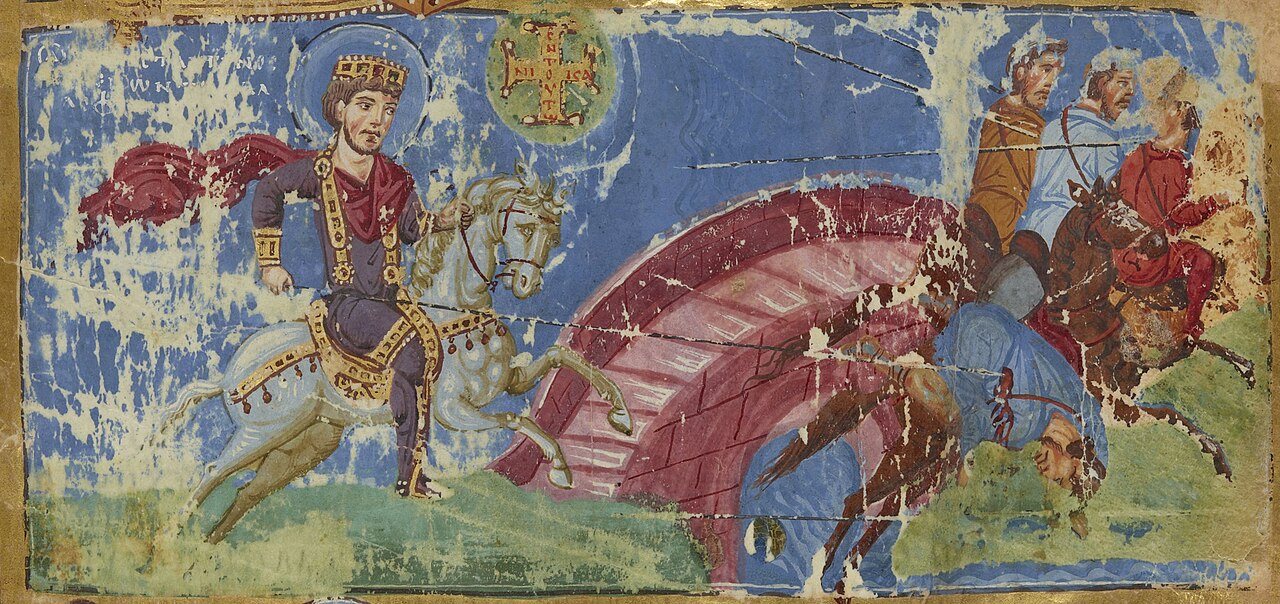
A ninth-century Byzantine manuscript painting of Constantine on horseback beneath a cross in the sky, with Maxentius's riders falling from a bridge. Bibliothèque nationale de France, public domain, via Wikimedia Commons
This is where the story stops being a straightforward military one. Lactantius says that before the battle Constantine was told in a dream to mark the heavenly sign of God on his soldiers' shields, and that he did so. The sign he describes is usually read as the Chi-Rho, the first two Greek letters of "Christ" laid over each other.
Eusebius of Caesarea tells a bigger story in his Life of Constantine, written after the emperor's death in 337. He says Constantine told him, and swore to it, that he and his whole army had seen a cross of light above the sun with the words "In this sign, conquer," followed by a dream in which Christ explained what it meant.
Historians have spent a long time on the gap between the two versions. One account is early and modest; the other is late, dramatic and came from the emperor himself many years on. Some scholars have suggested a natural sky effect such as a solar halo, and others see a story that grew with each telling. My own view, for what it's worth, is that something happened that Constantine chose to read as divine backing, and that the details improved with age. That is a guess, and I'll own it as one.
What came after October 28
The arch the Senate raised to honor Constantine, finished in 315 beside the Colosseum, is notably careful. Its inscription credits the victory to "the inspiration of the divinity" without naming which one, which was a tidy bit of drafting for a city that still had plenty of pagan senators.
In 313 Constantine and his fellow emperor Licinius agreed the policy usually called the Edict of Milan, which gave Christians legal freedom to worship and ordered confiscated church property returned. Constantine went on to fund churches, including the first basilica of St. Peter, and called the Council of Nicaea in 325. He was baptized only on his deathbed. Whether the Milvian Bridge was a real conversion or a shrewd alliance with a growing movement is still the main question. The sources, frustratingly, don't let us look inside his head.
Visiting the bridge and the arch today
The Ponte Milvio still stands in the north of Rome, and parts of the masonry are ancient, though the bridge has been repaired and rebuilt many times since. It is closed to cars now, and a pleasant walk if you're heading toward the Foro Italico. Some readers may remember it for another reason: in the 2000s it became a magnet for padlocks left by couples after a popular Italian novel, until the city cleared them away.
The Arch of Constantine is easy to find next to the Colosseum, and it's worth looking closely, because much of its sculpture was taken from older monuments to Trajan, Hadrian and Marcus Aurelius. Inside the Vatican Museums, the Hall of Constantine has a huge fresco of the battle by Raphael's workshop, with Maxentius going under in the river. Stand on the bridge itself on a late October afternoon and it's not hard to picture how quickly a retreating army ran out of room.
Enjoyed this story?Get a new one every day on social.