Photo: Dosseman, CC BY-SA 4.0, via Wikimedia Commons
In the summer of 1982 a sponge diver from Yalıkavak named Mehmet Çakir made a sketch of something he had seen on the seabed near Cape Uluburun, on Turkey's southern coast. He called them metal biscuits with ears, which is about the best description of a Bronze Age oxhide ingot anyone has ever given.
A team from the Bodrum Museum and the Institute of Nautical Archaeology went to look and found copper ingots lying about 50 meters from the shore. They had found the remains of a ship that went down more than 3,300 years ago, and a decade of diving would bring up what I think is the most useful single object in the study of the ancient Mediterranean: a complete snapshot of what one vessel was carrying on one bad day.
Eleven campaigns on a steep slope
The wreck sits on a rocky slope at 44 to 52 meters, with objects scattered down to 61. That is deep for excavation work, and a diver's time on the bottom at that depth is short.
George Bass began the dig for the institute in July 1984. Cemal Pulak directed it from 1985 until it ended in 1994. There were eleven campaigns of three to four months each, and the total came to 22,413 dives. I have read that number many times and it still seems like a misprint. The team mapped everything by triangulation, cleared sediment with air-lifts and talked to the surface over an underwater telephone. Conservation and study have carried on in Bodrum ever since, and more than three decades later the material is still being sampled.
Ten tons of copper, one ton of tin
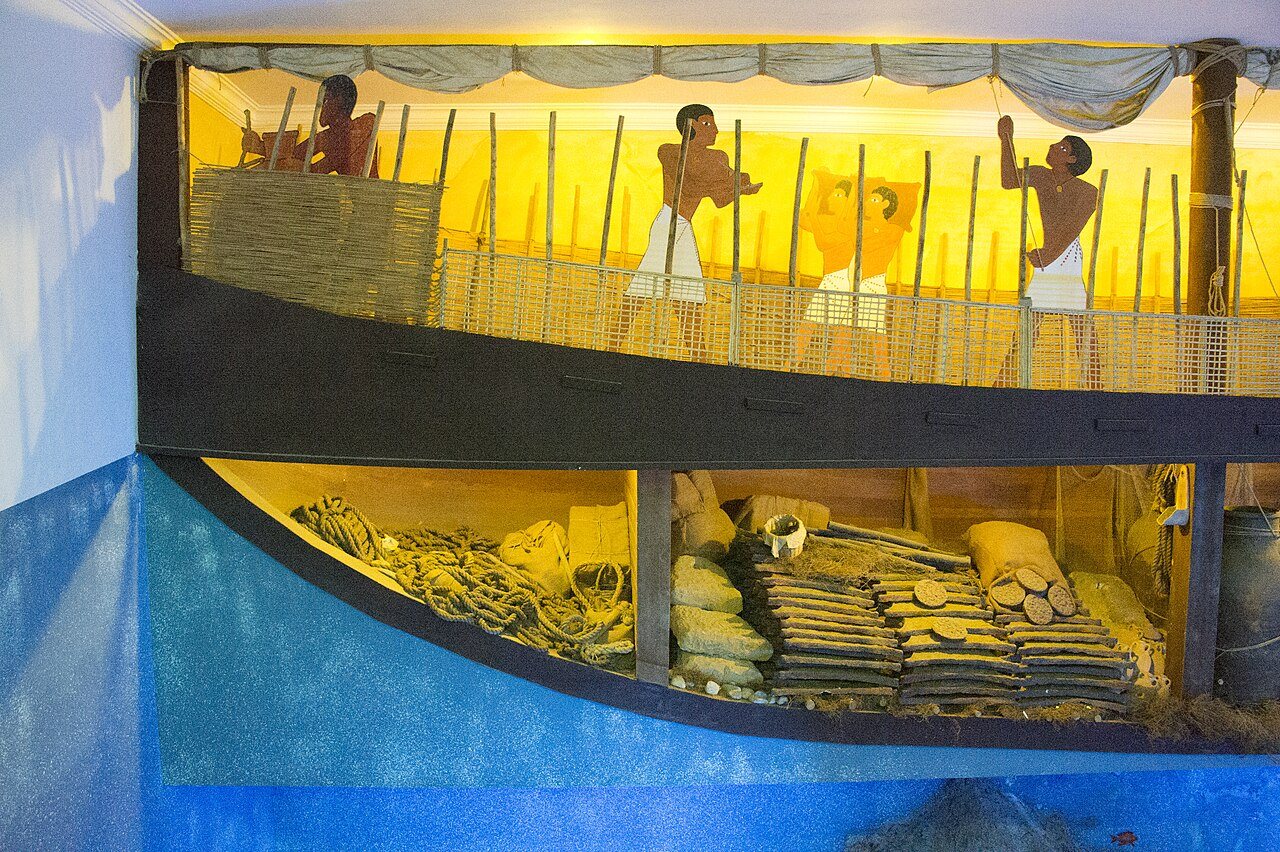
The ship itself was modest, about 15 meters long and 5 wide, with one mast and planks of Lebanese cedar. What it carried was anything but. There were 354 copper ingots weighing about 10 tons, most of them that oxhide shape with four handles, and the metal was pure Cypriot copper. Alongside them was about a ton of tin.
Roughly ten parts copper to one part tin is the recipe for bronze, so the hold effectively contained a kit for making the most important metal of the age. The tin had come a long way, too. Analysis points to about two thirds of it from the Kestel site in the Taurus Mountains, with around 30 percent from as far off as Tajikistan or eastern Uzbekistan.
The rest of the manifest reads like a shopping list for a palace. Some 175 raw glass ingots, mostly cobalt blue and turquoise, were packed aboard, along with 18 logs of African blackwood. About 150 Canaanite jars were stowed in the hold, roughly 100 of them holding terebinth resin, more than half a ton in all. There was a piece of elephant tusk, 14 hippopotamus teeth and three ostrich eggshells. There were also olives, grapes, figs and pomegranates, some of them perhaps lunch.
A scarab with Nefertiti's name
Dating the wreck took several kinds of evidence, and they do not line up perfectly. Tree rings from a branch aboard run to 1305 BC, though without bark nobody can say how many later rings are missing. Radiocarbon work led by Sturt Manning gave a likely sinking date of about 1320 BC, give or take 15 years. Most specialists settle on the end of the 14th century BC.
The small gold scarab bearing Nefertiti's name helps from the other direction. It means the ship cannot have sunk before her lifetime, and the pottery aboard fits the end of the Amarna period. So this vessel was afloat at around the time Tutankhamun was on the throne or not long after, which is the sort of link that makes a dry date suddenly feel close.
Who was aboard, as far as anyone can tell
No crew list survives, of course, so the people have to be worked out from their belongings. About 150 balance weights turned up, in four lots, which suggests four merchants. Those and the cylinder seals point to Canaanite traders from the Levant. Personal items from the Aegean, including swords and a drinking set, suggest two Mycenaean passengers of some standing. A third traveler, possibly a mercenary or an envoy, is implied by a few objects from the northern Balkans.
I find this the most persuasive part of the whole excavation, and also the most fragile. It is all inference from what people left in their bags, and a single borrowed sword could throw it off. Still, a ship with that mix of languages aboard feels right for the 14th century BC.
Then there is the writing board. Divers recovered fragments of two boxwood leaves joined by an ivory hinge, each with a recess for wax. Whatever was scratched into that wax has gone. Accounts of the find say no other Late Bronze Age board of this kind has turned up in the archaeological record, and it is hard not to think of the folded tablet mentioned in the Iliad. Somebody on that ship kept notes, and I would give a good deal to read them.
Where it was going
Pulak favors a home port in the Levant, on the evidence of anchors and pottery from around Mount Carmel, with Tell Abu Hawam, Tel Dor, Tell es-Samak and Tel Akko among the candidates. Ugarit and Cyprus have their supporters as well. The destination was most likely the Aegean, perhaps a Mycenaean center such as Tiryns or Pylos, and the excavation team reads the voyage as one chartered for a palace.
Others see a shipment of Egyptian gifts, or even a diplomatic or marriage mission. There is no clear evidence for any single version. C. Monroe once estimated the cargo at about 12,000 silver shekels, or around 112 kilograms of silver, though he had to guess at the value of the resin, so take that one as a rough figure.
Seeing it today
The wreck belongs to the Republic of Turkey, and the finds are displayed at the Bodrum Museum of Underwater Archaeology, inside the Castle of St. Peter, along with a replica of the ship. If you are ever in Bodrum, it is worth a morning. Go for the ingots, which look exactly like what Çakir said they did, and check opening hours before you set out.
Enjoyed this story?Get a new one every day on social.