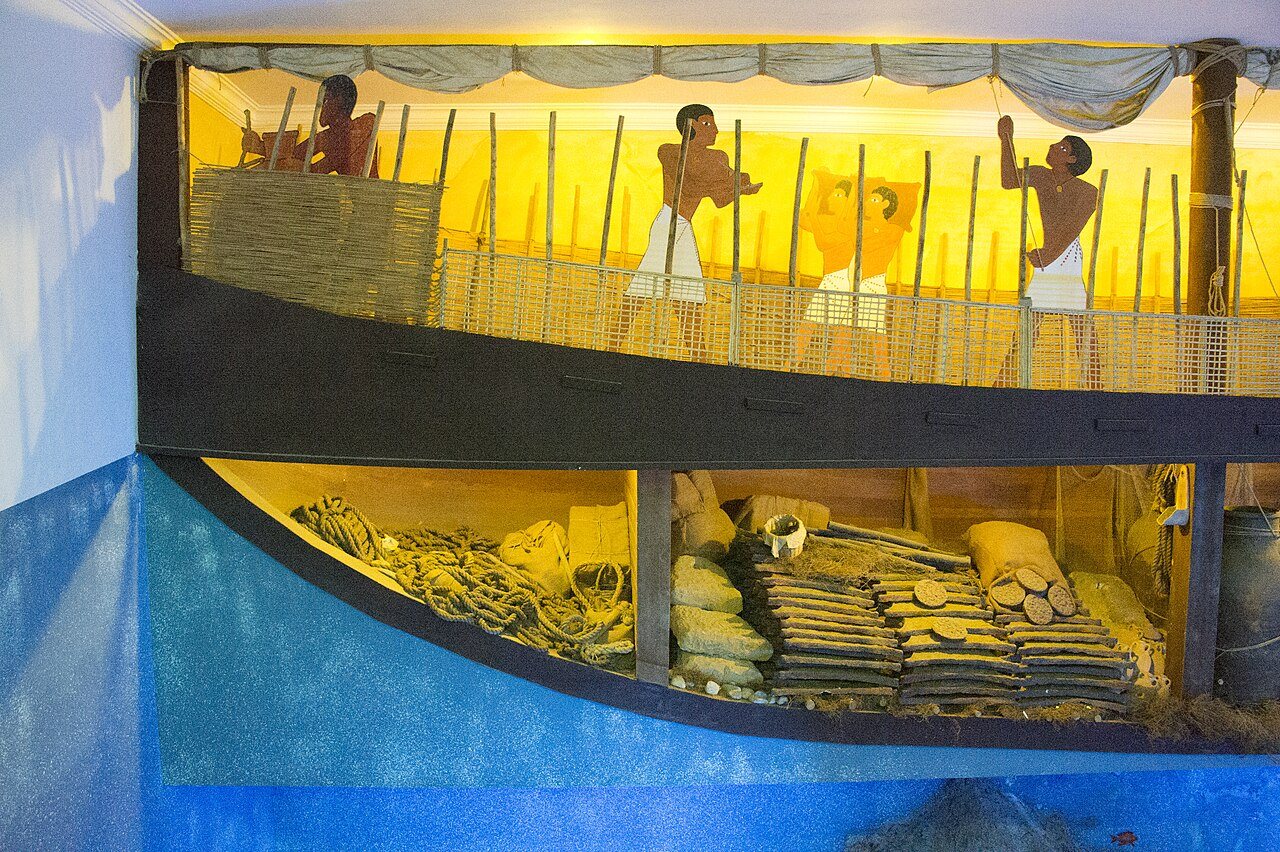
Photo: Steven James Fosdick, CC BY-SA 4.0, via Wikimedia Commons
The wood had been gone for something like thirteen centuries. What Basil Brown found in the spring of 1939, scraping back the sand inside the largest burial mound on Edith Pretty's estate in Suffolk, was a row of iron rivets still sitting where the planks had held them, and then another row beside it. Before long he could see the curve of a hull pressed into the ground, a bit like a leaf fossil in a split stone.
He kept going, slowly, with trowels and his hands. By the time he was done he had the outline of a ship roughly 27 metres long, every plank line marked by rust and stained sand. The boat itself had rotted to nothing, but its shape was all there.
Brown wasn't a university man. He was a local excavator from the Suffolk countryside, largely self-taught, with a good eye for soil. Pretty had hired him in 1938 to open the mounds on her land at Sutton Hoo, above the River Deben near Woodbridge. What he uncovered in Mound 1 is still the richest burial ever found in Britain.
A widow, a hunch and three robbed mounds
Edith Pretty had been curious about the mounds for years. In 1938 she brought in Brown, who started on three of the smaller ones. They were disappointing in the way old graves often are: robbers had been through them long before, and what was left was scraps. There were hints of something better, including fragments that suggested a boat burial, but nothing you would call treasure.
The next year he turned to the big mound, Mound 1. Here he had some luck. Earlier treasure hunters had dug into it too, but their trench missed the centre of the chamber. If they had dug a few metres to one side, there would be very little to write about.
A ship made of rust and shadows
Archaeologists sometimes call it a ghost ship, and once you see the 1939 photographs you understand why. The acidic sand had eaten the oak, so the excavators were following a ship that existed only as a pattern of rivets and darker soil.
It had been a clinker-built rowing boat, its planks overlapping, and it must have taken a great deal of effort to haul it up from the river to the top of the ridge. In the middle sat a burial chamber, a wooden room built into the hull and then buried under the mound.
Once word got out that this was serious, the professionals arrived. Charles Phillips of Cambridge took charge of the chamber in the summer of 1939, with a small team that included Stuart and Peggy Piggott. Brown, who had found the thing, was moved to the side. (He kept working on site, and his notes are still part of the record, but you can see why the 2021 Netflix film The Dig made so much of the snub.)
What the chamber held
The best known piece is probably the great gold buckle, which is hollow, heavy and covered in interlace. Next to it in the case you'll find a pair of gold shoulder clasps set with cut garnets and blue and white glass (I can't look at them without wondering how anyone's eyes survived the work). There was also a purse lid in the same garnet style, and inside it 37 gold coins from Merovingian France, plus three blank coins and two small ingots.
There was a sword, a shield, spears, a lyre, drinking horns and a pile of silver from the eastern Mediterranean, including a big dish stamped in the reign of the Byzantine emperor Anastasius. And there was the helmet, crushed into hundreds of pieces when the chamber roof gave way.
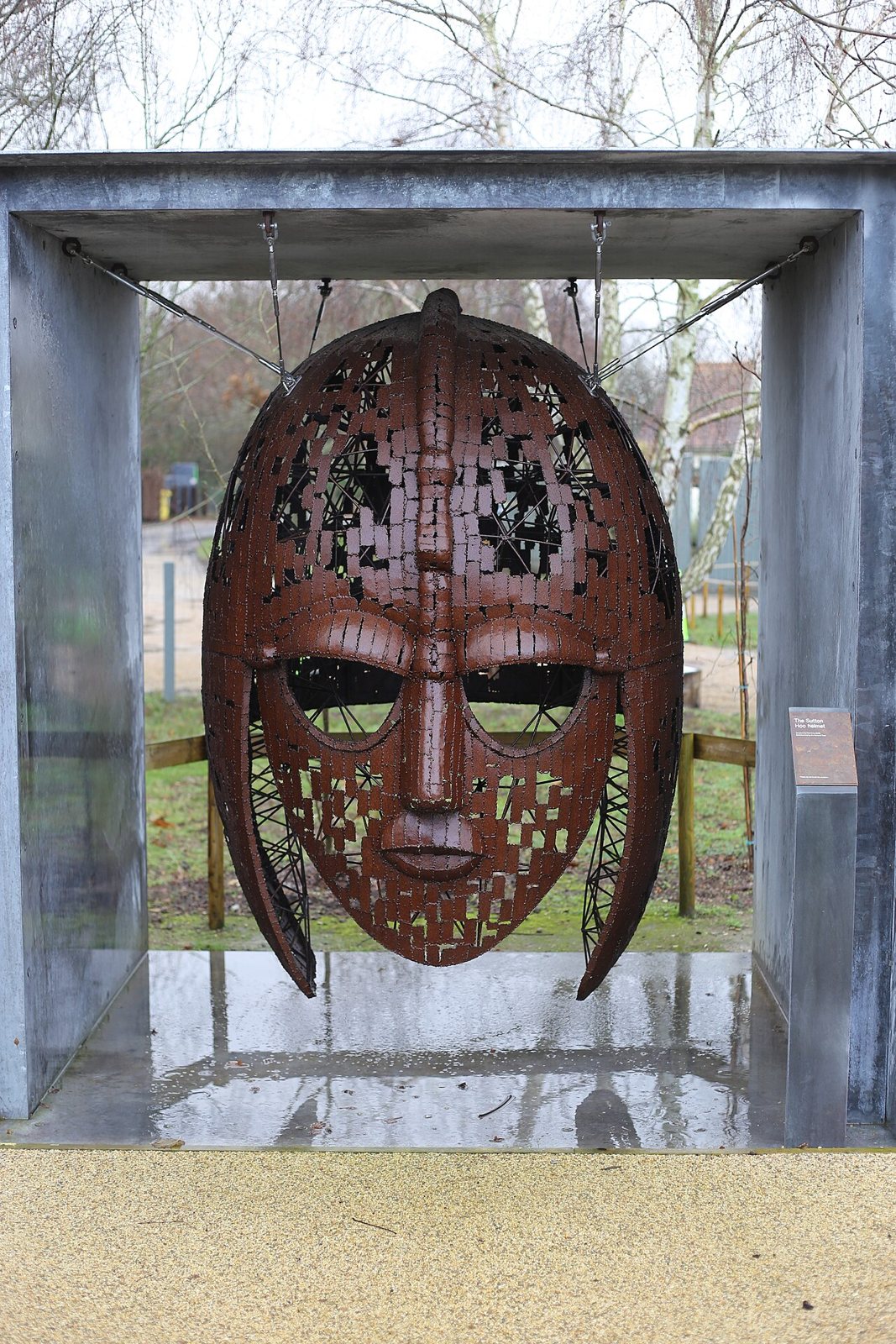
That helmet has now been rebuilt twice. Herbert Maryon at the British Museum had a go just after the war, and then Nigel Williams took it apart and reassembled it more convincingly in the late 1960s and early 1970s. The face mask, with its eyebrows and the little bird whose wings form the nose, is probably the most recognised image of Anglo-Saxon England.
A grave with no body
The excavators found no skeleton, which puzzled people for years. Some wondered if Mound 1 was a memorial rather than a grave.
The general view now is that a body was there and the acid soil simply dissolved it, the same way it dissolved the ship. Chemical tests on the chamber floor in the 1960s pointed that way.
As for who it was, the name you'll hear most is Rædwald, a king of the East Angles who died around 624. The coins fit that date, and the sheer wealth fits a king. Nobody has found anything with his name on it, though, so treat it as the best candidate rather than a settled fact. I lean towards Rædwald myself, but I'd be happy to be surprised.
The landowner who gave it all away
In August 1939 an inquest decided the hoard was not treasure trove, because it had been buried with no intention of digging it up again. That made it Edith Pretty's property. She gave the lot to the British Museum, a gift of staggering value, and turned down the honour she was offered for it.
The timing was grim. War broke out within weeks, the finds were packed away for safekeeping, and the long work of conserving and studying them only got going properly after 1945. Later digs, led by Rupert Bruce-Mitford in the 1960s and Martin Carver in the 1980s and 1990s, mapped the wider cemetery and found more burials, including a young man buried alongside his horse.
Seeing Sutton Hoo today
The objects are in Room 41 at the British Museum in London, and they are free to see. Go early if you want a quiet moment with the helmet and the buckle, because the cases fill up fast.
The site itself belongs to the National Trust. There isn't much to look at in the way of treasure, but standing among the grassy mounds above the Deben, you get a feel for why a king might want to be buried somewhere he could be seen from the water. A viewing tower lets you look down over the burial ground.
Down in Woodbridge, a volunteer group has been building a full-size reconstruction of the ship, plank by plank, working from those rows of rivets Brown traced in 1939. If you're in Suffolk, it's worth checking whether their shed is open to visitors before you go, because watching them fit oak to that old outline is the closest anyone gets to seeing what Brown saw.
Enjoyed this story?Get a new one every day on social.