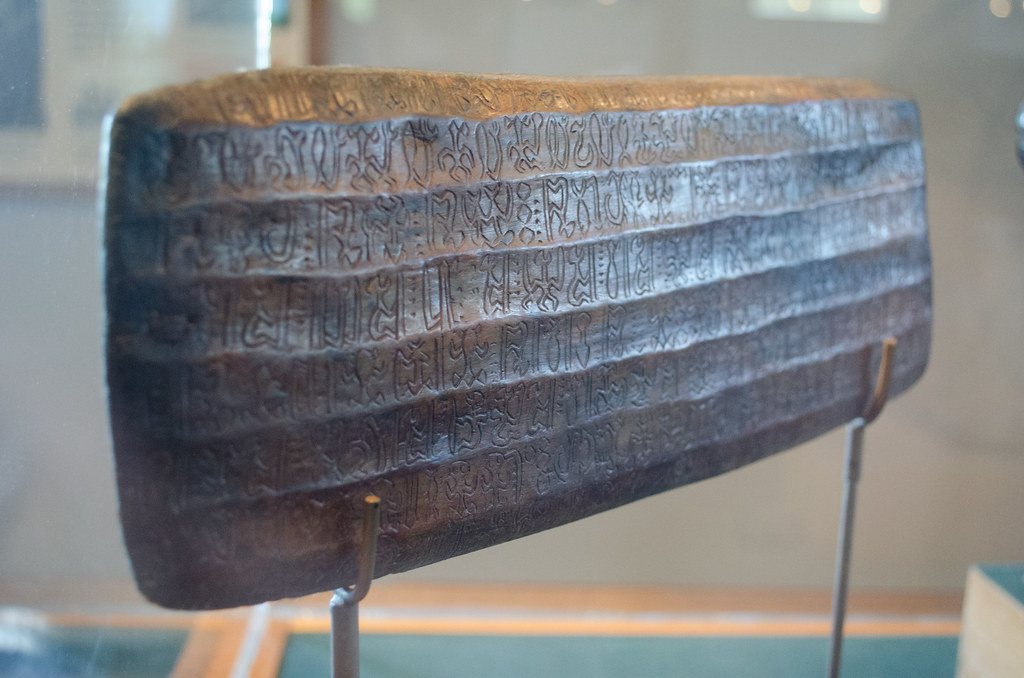
In 1864 a French lay missionary named Eugène Eyraud wrote home from Rapa Nui, the island Europeans call Easter Island, with a detail almost nobody had noticed before. In the houses he visited there were wooden boards covered in rows of small carved signs. He thought every house had some. He also noted that the islanders did not seem to set much store by them, and that nobody he asked would, or could, read them aloud.
That was the first real report of rongorongo, the only system of signs from Polynesia that looks like writing. Within a few years the boards were being collected, traded and shipped off to Europe and the Americas. Today roughly two dozen of them survive, and not one is on the island where they were made.
I have written about undeciphered scripts on this site before, and I always end up saying the same thing: a script stays unread when there is too little of it and nothing to compare it with. Rongorongo has both problems, plus a third that is much more painful.
What is actually carved on the tablets
The signs are small, neat and very varied. There are human figures with raised arms, birds, fish, turtles, things that look like plants, and plenty of shapes that look like nothing at all. Scholars count somewhere around 15,000 signs across all the surviving objects, which is a small corpus by the standards of decipherment. Linear B, which was cracked, left far more to work with.
The way they were laid out is odd, and rather lovely. The text runs in what specialists call reverse boustrophedon. You read one line left to right, then turn the whole tablet upside down to read the next, and so on. Every other line is upside down relative to its neighbours, so the reader has to keep rotating the board.
The carvers worked on wood, mostly on boards, though the longest text is on a staff now in Santiago, Chile. The tools were probably shark teeth or flakes of obsidian, the volcanic glass that is everywhere on the island. At least one of the tablets is carved on a reworked European oar, which tells you something about how valuable good wood had become there.
Why the readers disappeared
This is the painful part. In 1862 and 1863 slave raiders from Peru took somewhere around 1,500 people from Rapa Nui to work on the mainland. Most of them died. The few who were sent back brought smallpox with them, and it spread through the people who had stayed. A missionary count in 1877 found 111 islanders left.
If rongorongo was a specialist skill held by priests or chiefly families, as many researchers suspect, the people who knew it were among those lost in that decade. By the time outsiders took a serious interest, the chain of teaching had snapped.
The nearest thing to a reading session came in the 1870s. Florentin Étienne Jaussen, the Catholic bishop of Tahiti, had been sent a tablet as a gift and began collecting more. He found a Rapa Nui man working on Tahiti, Metoro Tau'a Ure, and asked him to read them. Metoro chanted over the tablets for days while the bishop wrote it all down. Later scholars have not been able to match what he said to the signs in any consistent way, and the usual view is that he was reciting what he knew while turning the boards, not reading them. (I find that one of the saddest scenes in the whole history of decipherment.)
The one passage people mostly agree on
There has been no shortage of attempts since. In the 1950s the German scholar Thomas Barthel studied a tablet known as Mamari and argued that one stretch of it was a lunar calendar, with signs for the phases of the moon in a sensible order. Most specialists accept that, at least in outline. It is the closest anyone has come to understanding a few lines of the script.
Other claims have not fared as well. In the 1990s the linguist Steven Roger Fischer announced that the long text on the Santiago staff was a set of creation chants. The idea got a lot of press and very little agreement from other researchers. Nobody has yet produced a reading that works across all the tablets and that other people can check, which is the real test.
The radiocarbon result from 2024
The big question underneath all of this is whether rongorongo was invented on the island before outsiders arrived, or after. Europeans first reached Rapa Nui in 1722, and a Spanish expedition in 1770 had island leaders make marks on a document claiming the place for Spain. Sceptics have long argued that seeing European writing may have given the islanders the idea.
In 2024 a team led by Silvia Ferrara of the University of Bologna published radiocarbon dates for four tablets held by a Catholic congregation in Rome, in the journal Scientific Reports. Three came from trees cut in the 18th or 19th centuries. The fourth came from a tree felled sometime between 1493 and 1509, roughly two centuries before Europeans showed up.
That does not settle it, and the researchers said as much. A date on wood tells you when the tree died, not when someone carved it. The wood of that fourth tablet also comes from a species that does not grow on the island, so it may have arrived as driftwood and sat around for a long time. Still, it is the first hard evidence that pushes the question back before contact, and I think it shifted the burden of proof a little.
Where to see the tablets today
If you want to look at rongorongo yourself, you will have to travel, because the tablets are spread across collections in Santiago, Rome, Washington, London, Berlin, Vienna, St Petersburg and Honolulu, among other places. Several museums have put good photographs online, which is the easier way to start.
People on Rapa Nui today have their own view of all this. The script is part of their heritage, and there have been calls for at least some of the tablets to come home. Whether or not anyone ever reads them, it seems fair that the islanders should be able to see them without buying a plane ticket to Europe.
If writing really was invented on Rapa Nui, it would put this tiny island in the same short list as Mesopotamia, Egypt, China and Mesoamerica, the places where people seem to have come up with writing on their own. That is still a big if, and I would not bet on a full decipherment in my lifetime. The 2024 dates did make it a more reasonable thing to argue about.
Enjoyed this story?Get a new one every day on social.