Photo: Głosik, public domain, via Wikimedia Commons
In May 1950, two brothers from the village of Tollund in central Jutland were cutting peat in a bog called Bjældskovdal, a few miles west of Silkeborg. Peat was still a household fuel in rural Denmark then, and digging it was dull, wet, physical work. Somewhere down in the brown wall of the cut, Viggo and Emil Højgaard saw a face.
It was a man's face, lying on its side, eyes shut, with a few days of stubble on the chin. He looked asleep. The brothers did what most of us would do and called the police, on the reasonable assumption that someone had gone missing and been dumped there not long before.
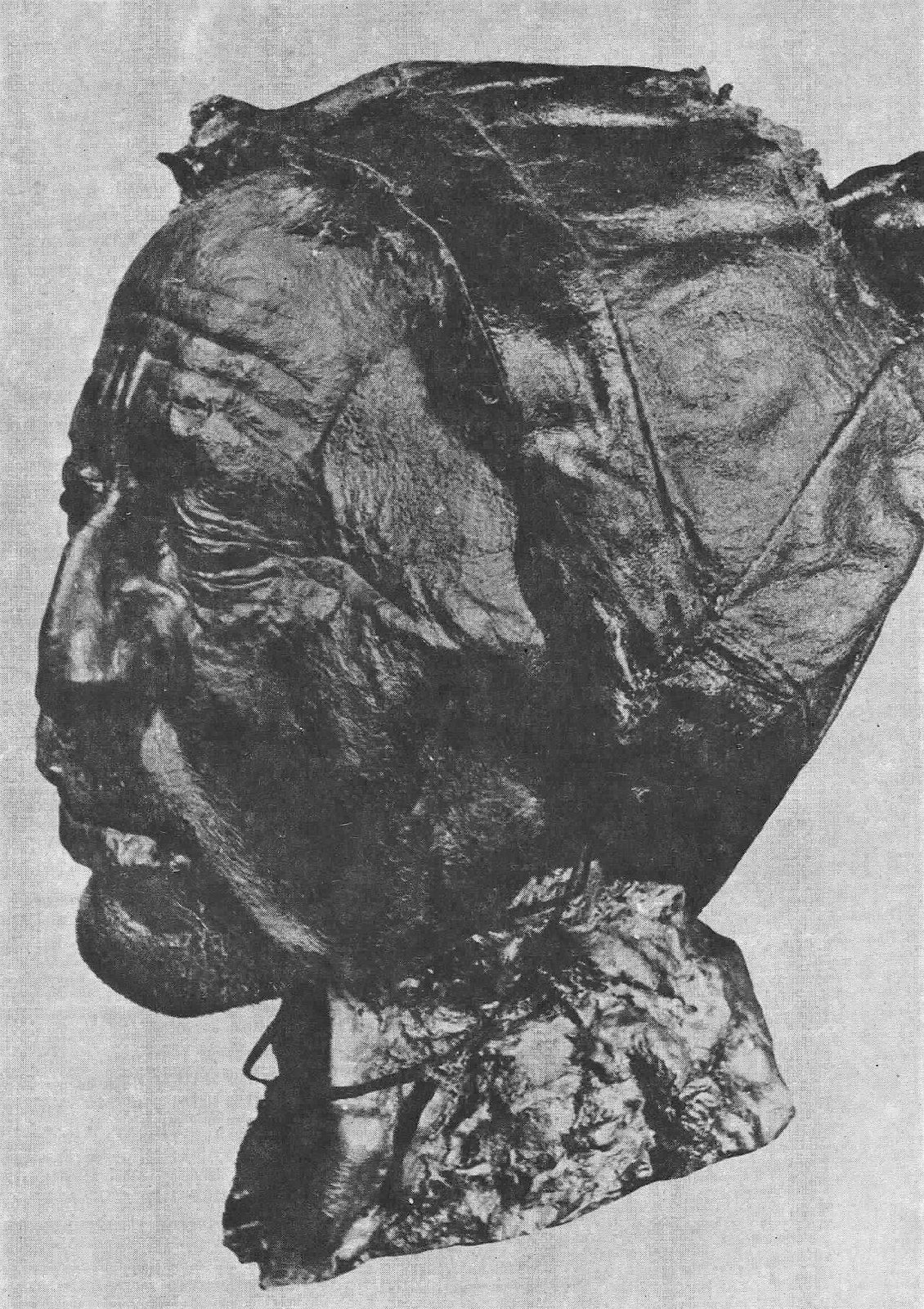
The police, to their credit, had seen bog finds before. They called in archaeologists. The man in the peat turned out to have died sometime in the fourth century BC, during what Scandinavian archaeologists call the Pre-Roman Iron Age. He had been in the ground for about 2,400 years. His stubble had survived, and so had the fine creases on his forehead.
What the bog kept and what it took
Raised bogs like Bjældskovdal are strange places chemically. The water is cold, acidic and starved of oxygen, and the sphagnum moss releases a compound that tans skin much the way a tannery tans leather. Bacteria that would normally break a body down can't do much work there.
The trade-off is that the same acid dissolves bone. Bog bodies often come out with skin, hair, nails and internal organs intact while the skeleton has softened or partly vanished. Tollund Man's skin had turned a deep brown, almost the color of the peat itself, and his body had been pressed and flattened by the weight above it. His face, though, came through in a condition that still surprises people who see the photographs for the first time. (I have looked at that profile many times and it has not stopped surprising me.)
A cap, a belt and a rope
He was found curled on his side, the way you might lie down in bed on a cold night. He wore a pointed cap made of sheepskin, fur side in, fastened under his chin with a leather strap. Around his waist was a thin hide belt. Apart from those two things he was naked.
There was one more item, and it changed the story. A plaited leather rope was looped tightly around his neck, with the long end trailing down his back. The marks it left in the skin under his chin and along the sides of his neck point to hanging as the cause of death. Whoever placed him in the bog then took some care over him: his eyes and mouth were closed and he was laid in that sleeping position rather than simply thrown in.
That combination of a violent death and a careful burial is what makes Tollund Man so hard to read. Was he executed for a crime? Offered as a sacrifice? Both at once, perhaps, if the community saw no great line between punishment and offering. The Danish archaeologist P. V. Glob, who examined him and later wrote the classic book The Bog People, leaned toward a ritual killing connected with fertility and the turning of the seasons. That reading has been influential, though it is an interpretation rather than something the body itself can prove.
His last meal
Because his internal organs survived, researchers have been able to look inside his stomach and intestines more than once since 1950. The early analysis found the remains of a porridge or gruel made from barley, flax and the seeds of various wild plants, some of them what a modern gardener would call weeds.
A fresh study published in 2021 in the journal Antiquity went back over the gut contents with newer techniques. It confirmed the porridge, added evidence that he had eaten some fish, and estimated that the meal was eaten roughly 12 to 24 hours before he died. The same work found the eggs of several intestinal parasites, including whipworm, which tells you something unglamorous about everyday hygiene in Iron Age Jutland.
Plenty of writers have tried to make the meal into a ritual last supper. It may have been. It also looks a lot like what ordinary people ate at that time of year, so I would hold that idea loosely.
Only the head is real
Conservation science in 1950 was not ready for a whole bog body. The team at the National Museum in Copenhagen decided to preserve the head, treating it with a sequence of chemicals and paraffin wax. It worked, more or less, though the head shrank noticeably in the process.
The rest of the body was not so lucky. It dried out and was largely lost, with only a few small parts kept alongside the head. The full figure that lies in the case at Silkeborg Museum today is a reconstruction made in the 1980s, with the genuine head placed on a replica body. The museum is open about this, but you would be surprised how many people walk past assuming the whole thing is original.
Neighbours in the same bog
Tollund Man was not alone in Bjældskovdal. In 1938, a little over a decade earlier, peat cutters in the same bog had found the body of a woman, now known as Elling Woman. She had also died by hanging, and she lies in the same museum.
Denmark has produced hundreds of bog bodies over the centuries, many of them recovered before anyone knew how to look after them. Grauballe Man, found in 1952 not far away, is the other famous one, and he is displayed at Moesgaard Museum near Aarhus. Together these finds have shaped much of what we think we know about religion and violence in northern Europe before the Romans arrived, which is a heavy load for a few leathery individuals to carry.
Seeing him for yourself
If you want to meet Tollund Man, Silkeborg Museum is the place, and it is an easy trip from Aarhus by train or bus. The display is quiet and well lit, and the head sits close enough to see the stubble and the creases on his forehead. Allow time for Elling Woman as well; she gets less attention, which feels a little unfair.
For reading, Glob's The Bog People is now old and some of its theories have been questioned, but it is still a fine piece of writing and the reason many people know these bodies at all. The poet Seamus Heaney read it and wrote "The Tollund Man", which is worth finding. And if you only take one thing away, let it be the picture of two brothers in a wet bog in 1950, reaching for the telephone because a face in the peat looked far too fresh to be anything but recent.
Enjoyed this story?Get a new one every day on social.