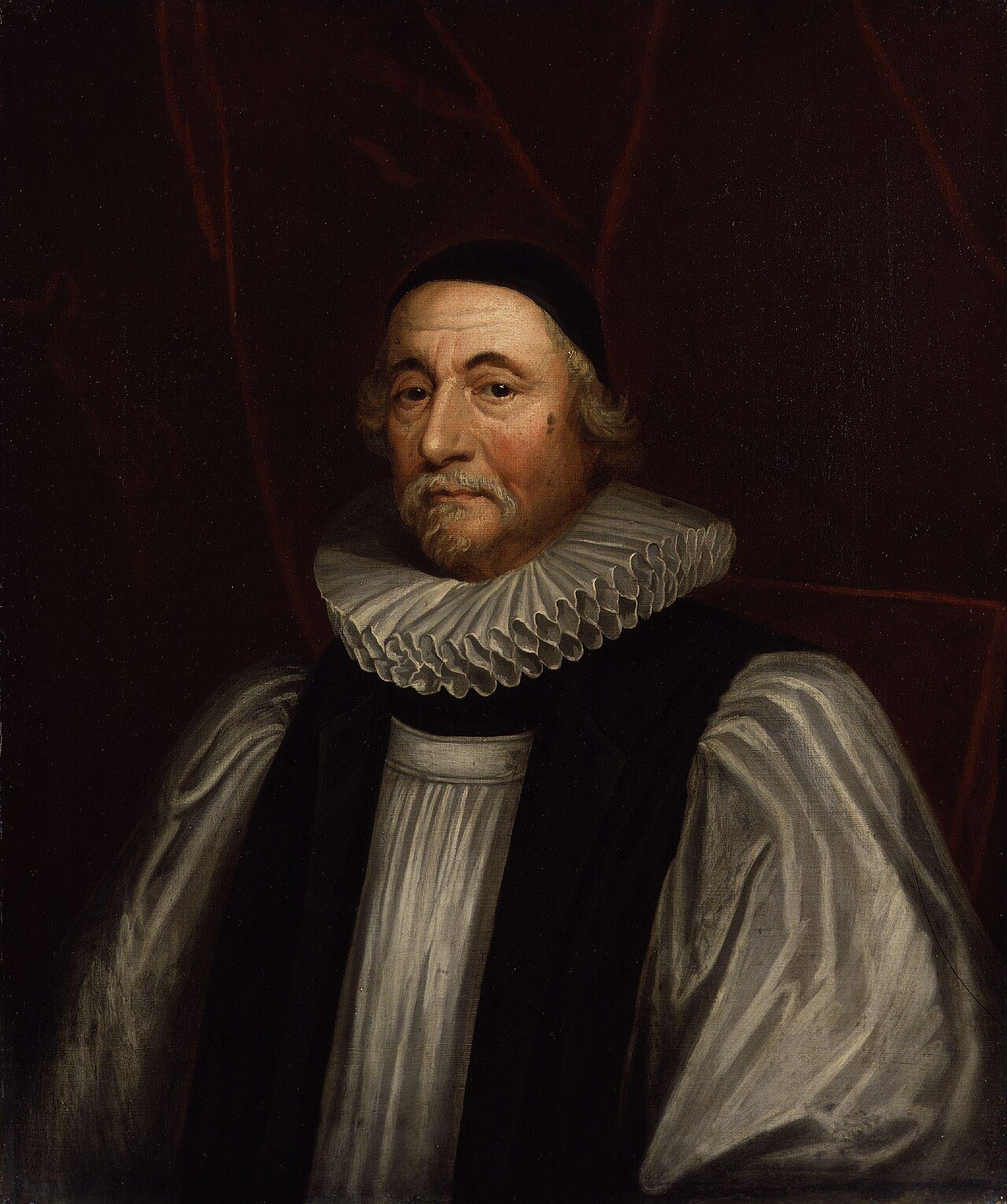
After Peter Lely, public domain, via Wikimedia Commons
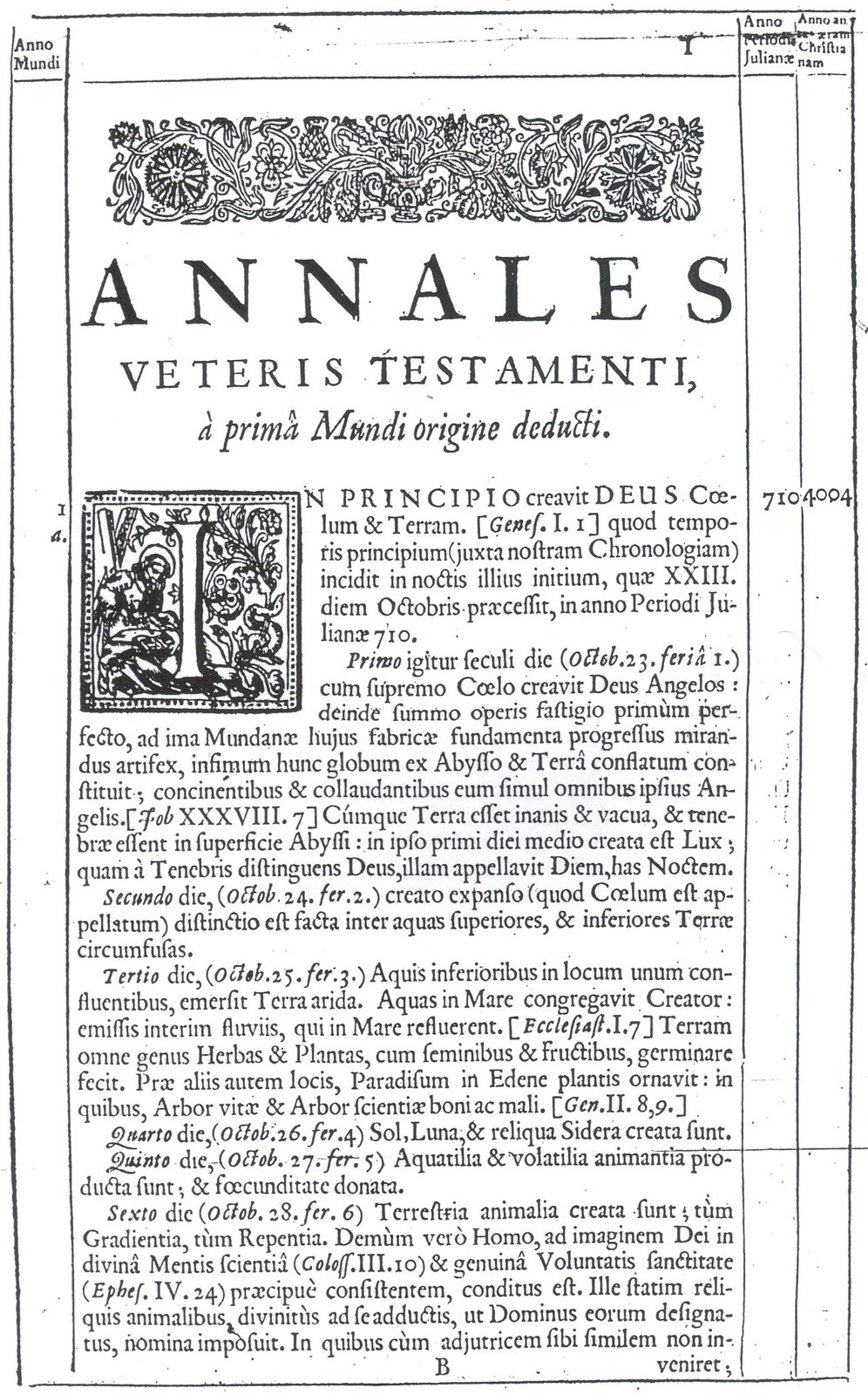
If you had asked James Ussher how old the world was, he would not have given you a round number. He would have given you a date, and a time of day. In his Annales Veteris Testamenti, published in 1650, the Archbishop of Armagh put the beginning of creation at the "entrance of the night" preceding Sunday, October 23, in the year 4004 BC.
So, by his reckoning, the world has a birthday today. It turns 6,029 this evening (give or take a few billion years, but we'll come to that).
Ussher has spent the last century or so as a punchline, the man who thought the Earth was six thousand years old. That's fair as far as it goes. But the joke tends to skip over how he arrived at the figure, and the method is more interesting than the answer.
Who James Ussher was
Ussher was born in Dublin in 1581 and was among the first students at Trinity College Dublin, which had opened only a few years earlier. He became Archbishop of Armagh, head of the Church of Ireland, in 1625. By the standards of his day he was a heavyweight scholar: he read Hebrew, Greek and Latin, collected manuscripts on a grand scale, and corresponded with the leading chronologers of Europe.
He also lived through a rough century. The Irish rebellion of 1641 drove him to England, where he stayed through the Civil War. He was a royalist, yet when he died in 1656 Oliver Cromwell gave him a state funeral and a burial in Westminster Abbey. That alone tells you how much weight his name carried.
Counting backwards from kings and begats
Ussher was not the first person to try to date creation, and he did not pull 4004 out of the air. Chronology was a respectable branch of learning in the 1600s, and the basic method was shared by everyone who tried it.
You start with the Hebrew Bible, which gives the ages of the patriarchs from Adam to Abraham and beyond. Then you work through the reigns of the kings of Israel and Judah. Somewhere around the Babylonian exile, the biblical record has to be tied to dates that can be fixed from outside sources, such as Babylonian and Persian king lists and the reigns recorded by classical historians. Ussher leaned on those outside anchors heavily, and that cross-checking is where most of his effort went.
The difficult part is the joins. The biblical text has gaps and overlaps (co-regencies, reigns counted in different ways, numbers that differ between the Hebrew text and the Greek Septuagint). Every chronologer had to make judgment calls, and those calls are why the answers varied. Bede, back in the eighth century, had come up with 3952 BC. The French scholar Joseph Scaliger worked out 3949 BC. Johannes Kepler, better known for the planets, landed on 3992 BC. Ussher's 4004 sat comfortably inside that crowd.
Why 4004 and not 4000
The four extra years are the giveaway that Ussher was working carefully. He accepted the common view that creation and the birth of Christ were separated by four thousand years. He also accepted the scholarly argument that Herod the Great died in 4 BC, which meant Jesus had to be born no later than that. The monk who laid out the AD system centuries earlier had simply put the starting point in the wrong year. Push the birth back to 4 BC, keep the 4,000 years, and you get 4004.
Why October 23
The opening page of Ussher's Annales Veteris Testamenti, with the year 4004 printed in the margin. James Ussher, public domain, via Wikimedia Commons
The month and day come from a different line of reasoning. Many scholars of the period assumed the world had been created in autumn, partly because the Jewish civil year began then, and partly because it seemed sensible to them that the fruit in Eden would be ripe and ready. Ussher placed creation near the autumn equinox and then picked the first Sunday after it, because the first day of creation week ought to be the first day of the week.
Using the Julian calendar and his own astronomical tables, that worked out to Sunday, October 23. Creation began at nightfall on the evening before, following the Jewish custom of counting a day from sunset.
The often-repeated claim that Ussher specified nine o'clock in the morning is, as far as I can tell, a later mix-up with the Cambridge scholar John Lightfoot, who wrote about the hour of creation separately and came up with a different year. Ussher's own text is about the evening.
How the date ended up in people's Bibles
A Latin chronology published in 1650 does not usually become household knowledge. What made Ussher's date famous was the margin. From 1701, editions of the King James Bible began printing his dates alongside the text, starting with an edition prepared under Bishop William Lloyd. Generations of English-speaking readers opened Genesis and saw "4004" printed beside the first verse, with no indication that it came from a 17th-century archbishop rather than the scripture itself.
That is how one man's careful estimate turned into something many people treated as gospel, more or less literally. I suspect Ussher, who knew exactly how many judgment calls sat behind his number, would have been uneasy about that.
What geology did to the number
From the late 1700s onward, geologists looking at rock layers, erosion and fossils kept finding that the Earth needed far more than six thousand years. The question of exactly how much more took another century and a half to settle. Radiometric dating eventually did it, and in 1956 the geochemist Clair Patterson published an age for the Earth of about 4.55 billion years, based on lead isotopes in meteorites. The current figure is close to that.
So Ussher was off by a factor of something like 750,000. That's a lot of zeroes. In fairness, he was answering the question with the best written evidence his world had, and he showed his working, which is more than can be said for plenty of people who have been confidently wrong since.
The palaeontologist Stephen Jay Gould made a version of this argument in an essay defending Ussher, pointing out that mocking him for not knowing about radiometric dating misses what he was actually doing.
If you want to see his work
Ussher's own library, thousands of books and manuscripts, ended up at Trinity College Dublin, the university he had helped open as a student. The Annales are also easy to find in digitised form, both in Latin and in the English translation published in 1658 as The Annals of the World. Read even a few pages and the effort is obvious. It is a long, dense, footnoted attempt to line up every king and every year in order.
And if you happen to be outside after dark this evening, you are, by Ussher's calendar at least, standing at the start of the world's 6,030th year. Worth a slice of cake, I'd say.
Enjoyed this story?Get a new one every day on social.