Photo: Richard from USA, CC BY 2.0, via Wikimedia Commons
On the evening of October 27, 1966, CBS aired a half-hour cartoon called It's the Great Pumpkin, Charlie Brown. Linus spent the night in a pumpkin patch waiting for a holiday spirit who never came. Charlie Brown went trick-or-treating in a white sheet he had cut so many holes into that he could barely see out of it, and at every house he was handed a rock.
That sheet is probably the most famous homemade costume in television history. It is also a neat snapshot of where Halloween stood in the mid-1960s, halfway between the old tradition of making your own disguise and the newer habit of buying one in a box at the five-and-dime.
Sixty years on, the costume aisles are already half picked over for Saturday night, and the bedsheet ghost is still out there every year. Here is roughly how the boxed costume took over, and why it never quite won.
Crepe paper and the Bogie Books
In the early 1900s a Halloween costume in America was mostly something you made. Old clothes, a bedsheet, burnt cork for a beard, a mask cut from cardboard. For families who wanted something more festive, the Dennison Manufacturing Company of Framingham, Massachusetts, had an answer, and it was crepe paper.
Dennison sold paper goods, and starting around 1909 it published Bogie Books, small annual guides full of ideas for Halloween parties, table decorations and costumes, nearly all of which happened to call for Dennison crepe paper. Witches, black cats, pumpkins and bats could be cut, gathered and pinned together at the kitchen table. It was clever marketing, and the costumes themselves were often lovely, if you didn't mind them tearing the first time someone sat down.
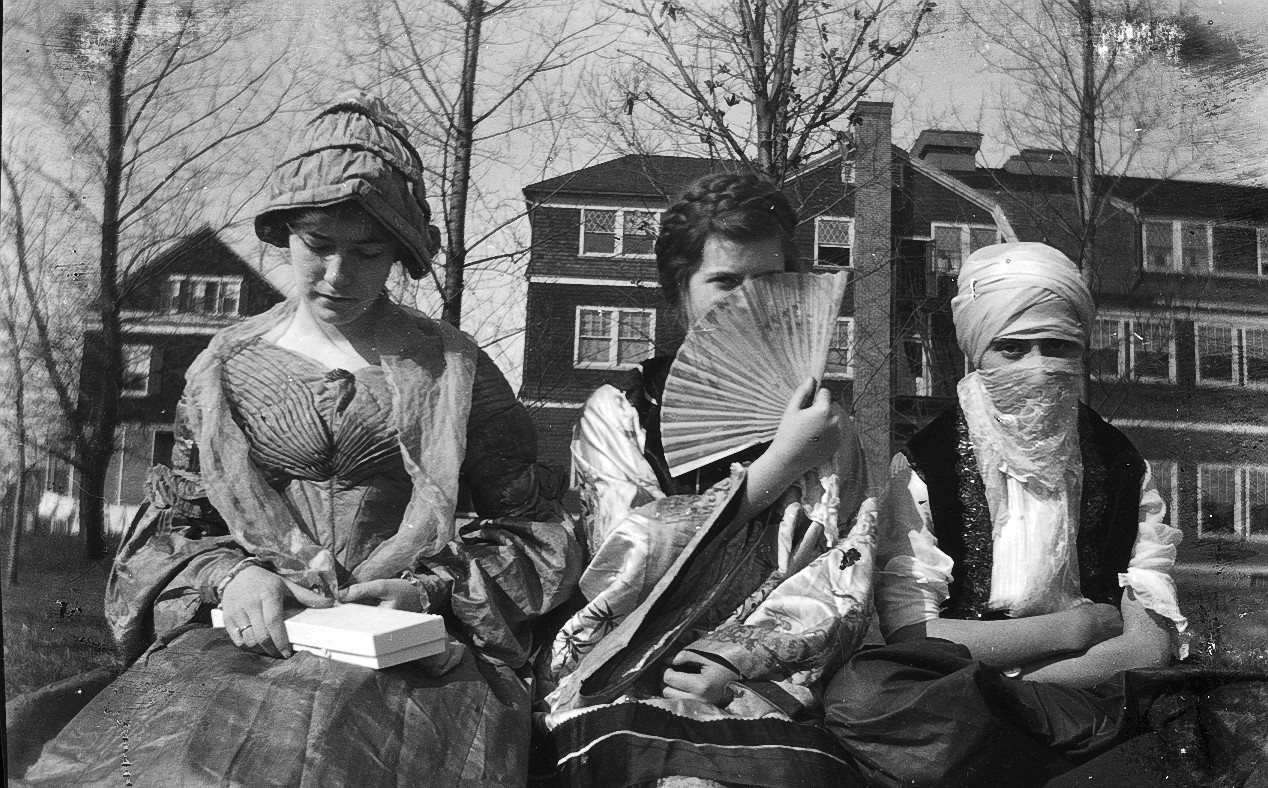
The photograph at the top of this story, dated 1918, shows the other common approach. Three young women have raided a trunk for a bonnet, a silk robe, a fan and a turban. Nobody is dressed as anything scary. For a long stretch of the early century, Halloween dress-up meant playing a character as much as playing a ghoul.
When costumes started coming in a box
Store-bought costumes arrived earlier than most people assume. Collegeville Flag and Manufacturing, a Pennsylvania company that began by making flags, was producing costumes based on licensed characters by the 1920s. A firm called H. Halpern, better known as Halco, sold Popeye, Olive Oyl and Wimpy outfits in the same era.
The name most baby boomers remember, though, is Ben Cooper. The New York company bought the rights to Disney's Snow White in 1937, the year the film came out, and went on to dominate the business. By some estimates Ben Cooper held around 70 to 80 percent of the American Halloween costume market in the 1960s.
The formula barely changed for decades. You got a thin, brittle plastic mask held on with an elastic band, and a body piece of printed plastic sheeting or cheap fabric that often had the character's name written across the front, in case the neighbors were unclear who you were supposed to be. The box usually had a little cellophane window so you could see the mask's face staring back at you from the store shelf.
Trick-or-treat finds its name
The phrase "trick or treat" was not always part of the holiday. The earliest printed use usually cited comes from a 1927 newspaper report in Alberta, Canada, describing children going door to door. Through the 1930s the custom spread, sometimes alongside real pranks that worried town councils and police.
Then the Second World War got in the way. Sugar rationing in the United States made candy scarce, and Halloween festivities shrank in a lot of places. After the war, with new suburbs full of young families and front doors close together, trick-or-treating turned into the mass ritual it is today. By 1952 Disney had made a Donald Duck cartoon simply called Trick or Treat, which tells you the phrase no longer needed explaining.
The sweaty glory of the plastic mask
Anyone who wore one of those boxed masks remembers the experience in fairly specific terms. The eyeholes never quite lined up with your eyes. The mouth slit fogged with breath. The elastic snapped by the third street, and from then on you held the mask to your face with one hand and the candy bag with the other.
There was a real safety issue with some of it, too. Cheap costume fabrics could be flammable, which mattered on a night of candlelit jack-o'-lanterns. Congress passed the Flammable Fabrics Act in 1953, and costume makers, like every clothing maker, had to start paying attention to what their fabric did near a flame.
Why the homemade costume never went away
Ben Cooper's long run eventually ended. The company filed for bankruptcy more than once, and Rubie's Costume Company later bought what was left. Costume tastes moved on toward latex masks, full jumpsuits and, these days, adult costumes that cost more than a nice dinner out.
The homemade costume, meanwhile, just kept going. Some of that is thrift. Some of it, I suspect, is that kids like being asked what they want to be and then watching a grown-up figure out how to build it out of whatever is in the closet. Charlie Brown's sheet works as a joke precisely because every viewer had either worn a costume like it or watched a little brother try.
If you want to try a vintage costume this week
The old methods still work with almost nothing. A plain sheet with two carefully placed eyeholes (two, Charlie Brown) makes a perfectly good ghost. Crepe paper is still sold in craft shops and is easy to stitch or glue onto an old shirt for a pumpkin or a black cat. Digitized copies of the old Dennison Bogie Books can be found through public library and archive collections if you want period patterns to copy.
If you'd rather go fully retro, original boxed costumes from the 1960s and 1970s turn up at flea markets and online, sometimes still in the box with the cellophane window intact. I'd frame the mask rather than wear it, though. Anyone who has breathed through one of those mouth slits for an evening will understand why.
Enjoyed this story?Get a new one every day on social.