Photo: Acme News Photos, public domain, via Wikimedia Commons
At 8 p.m. Eastern time on Sunday, October 30, 1938, CBS radio listeners tuning in to the Mercury Theatre on the Air heard an announcer introduce a dramatization of H.G. Wells's novel The War of the Worlds. A few minutes later the program seemed to give way to dance music from a hotel ballroom in New York. Then the music kept getting interrupted.
A professor at an observatory had spotted explosions on Mars. A meteorite had come down on a farm near Grover's Mill, New Jersey. A reporter on the scene described something unscrewing itself from inside the object, and then the reporter's microphone went dead.
None of it was real, of course. The next morning, newspapers across the country ran front-page stories saying it had sent thousands of Americans fleeing into the streets. That part is the one I want to look at, because it is mostly not real either.
A 23-year-old and a borrowed novel
Orson Welles was 23 that fall and already famous in New York theater. His Mercury Theatre company had a weekly hour on CBS, but it ran without a sponsor, and it was up against one of the most popular shows on the air: ventriloquist Edgar Bergen and his dummy Charlie McCarthy on NBC.
The script was written by Howard Koch, working under producer John Houseman, and the story goes that they worried the adaptation was too dull. Wells's 1898 novel is set in Victorian England and told as a memoir. Koch moved the landing to New Jersey and told the first half of the story as a series of breaking news bulletins, live remotes and official statements.
I'd argue that choice is the whole reason anyone remembers the show. Radio news was still fairly new, and listeners had spent the previous month hearing real bulletins interrupt programs during the Munich crisis in Europe. The Mercury broadcast borrowed that sound almost exactly.
The program everyone heard about and few heard
The broadcast announced itself as fiction at the start, again around the 40-minute mark, and again at the end. Anyone who heard the opening knew what they were listening to.
The popular explanation for the panic is that many listeners spent the first part of the evening on NBC, waiting through Charlie McCarthy, and switched dials when a less interesting act came on. They landed in the middle of the Martian bulletins with no idea it was a play. That's plausible, and it's been repeated so often it's hard to know how much of it is evidence and how much is a tidy story.
What we do know is that the audience was small. A C.E. Hooper ratings survey taken that night reportedly found only about 2 percent of the households it called were listening to the Mercury program. Most of America was listening to something else, or to nothing at all.
How the papers made a panic
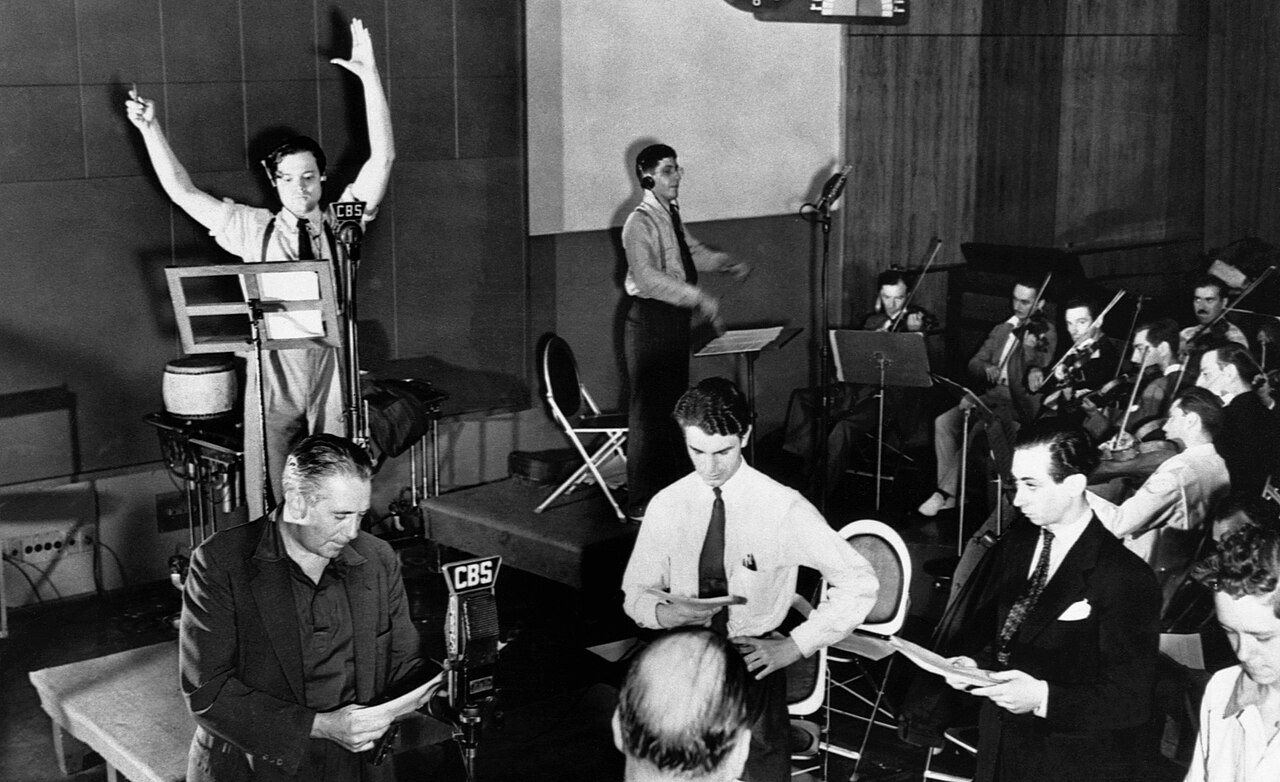
Orson Welles, arms raised, conducting a Mercury Theatre radio rehearsal at CBS in 1938 with actors and an orchestra (Photo: Acme Telephoto, public domain, via Wikimedia Commons)
Some people really were frightened. Police stations and newspaper offices got calls that night, and there were scattered reports of people leaving their homes. In Grover's Mill itself, the story goes, a few locals fired at a water tower they took for a Martian machine. I'd file that one under "probably embellished," but it has never quite gone away.
The scale of it came mostly from the press. The New York Times ran the headline "Radio Listeners in Panic, Taking War Drama as Fact" the next day, and papers everywhere followed with stories of mass hysteria, many built on anecdotes and phone calls rather than anything like a count.
The media historians Jefferson Pooley and Michael Socolow made the case in 2013 that newspapers had good reason to play it up. Radio had been taking advertising money away from print for years, and a story about reckless radio producers terrifying the public was a convenient one to run. I think they're mostly right, though I wouldn't go as far as saying nobody was scared.
Welles says sorry, mostly
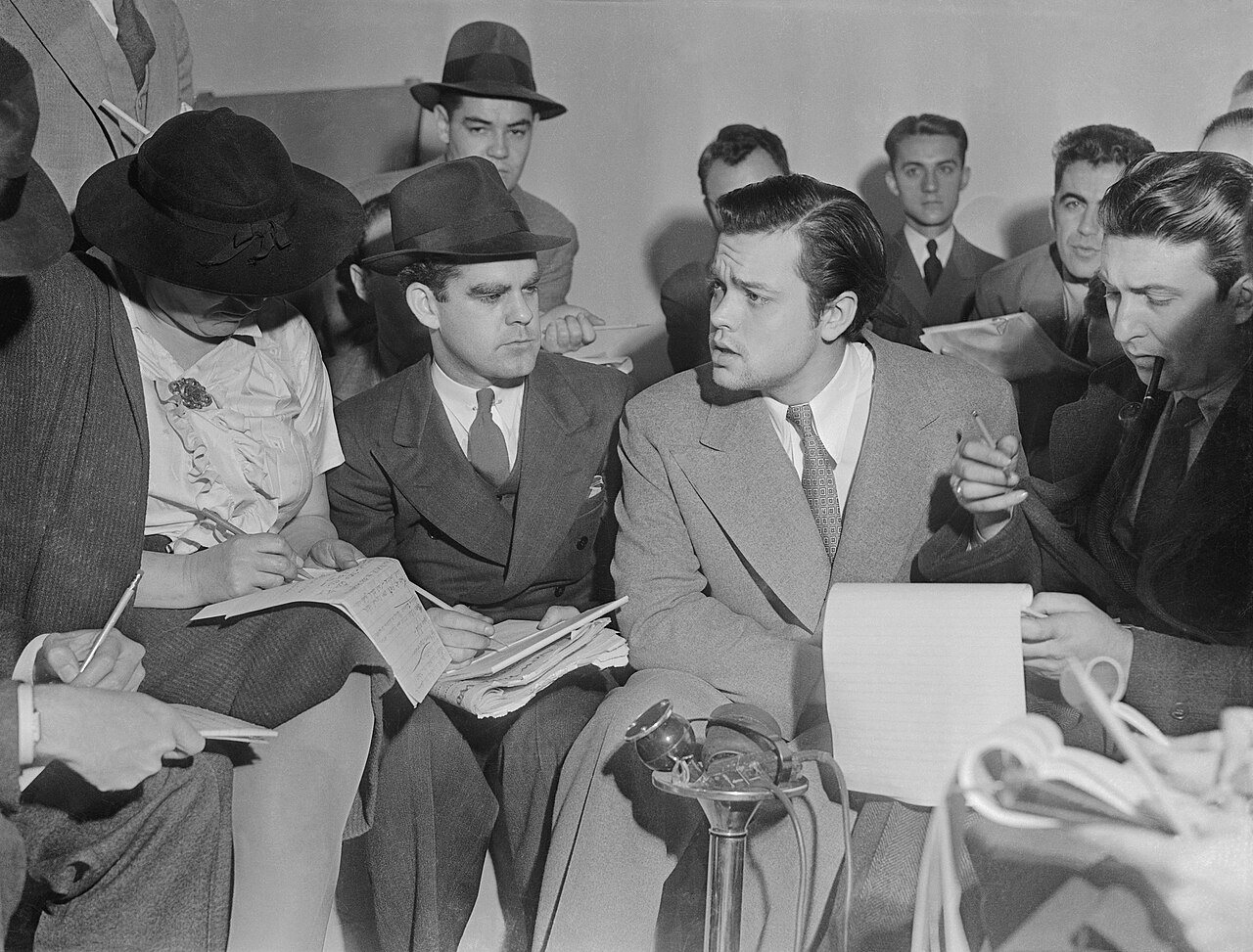
The morning after, Welles faced reporters at CBS, which is the scene in the cover photo. He looked tired and contrite and said he had no idea the show would be taken as real. Whether he believed that is another question. He was a showman to the bone, and he had closed the broadcast by telling listeners it was the Mercury Theatre's own version of dressing up in a sheet and jumping out of a bush to say "Boo!"
The Federal Communications Commission looked into the broadcast and took no action against CBS, though networks became more careful about fake news bulletins in dramas. The Mercury company did fine out of it. Campbell's Soup picked the show up as a sponsor within weeks, and it became The Campbell Playhouse. Hollywood came calling too, and by 1941 Welles had made Citizen Kane.
The study that counted a million scared listeners
The most quoted numbers come from a 1940 Princeton study by the psychologist Hadley Cantril, published as The Invasion from Mars. Cantril estimated that around 6 million people heard the broadcast and that roughly a million of them were frightened or disturbed by it.
Those figures got built into a lot of later writing about how easily mass media could sway people. The trouble is that Cantril's estimates leaned on survey work done weeks later, after the newspaper coverage had told everyone how frightened they were supposed to have been. Being "disturbed" by something on the radio is also a long way from running into the street. So treat the million with some caution.
Where to hear it now
The full recording survives and is easy to find through archives and old-time radio collections. It's worth an hour of your evening, ideally with the lights low. The first half still works remarkably well, and the second half, a quieter monologue by Welles as a survivor, shows how much the show actually owed to the novel.
If you're ever near Princeton, Grover's Mill has a small monument in Van Nest Park, put up for the 50th anniversary in 1988, showing Welles at a microphone and a Martian machine looming over a family by their radio. I've always liked that the town chose to commemorate the broadcast with a joke at its own expense rather than pretend it never happened.
Enjoyed this story?Get a new one every day on social.